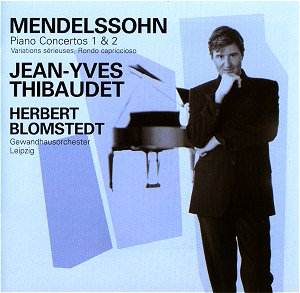
Mendelssohn: Piano Concertos Nos. 1 & 2; Variations sérieuses; Rondo capriccioso
Jean-Yves Thibaudet, piano; Leipzig Gewandhaus Orchestra/Herbert Blomstedt
Decca 468 600–2 (57:45)
There’s something odd going on here—a curious disconnect between what Jeremy Siepmann’s otherwise admirable booklet essay promises and what actually emerges from the speakers. Siepmann invokes Rudolf Serkin’s “electrifyingly virile” recordings, suggesting Thibaudet shares that robust approach to works once dismissed as salon fodder. But listen to these performances, particularly the G minor Concerto, and you’ll find something quite different: brilliance, certainly, but of a peculiarly weightless variety.
The outer movements of the First Concerto simply fly. Thibaudet’s fingers are astonishing—every note accounted for, every run crystalline. Yet where’s the bite? The scintillation that makes this music dangerous rather than merely decorative? I kept thinking of Cherkassky in his prime, that combination of technical wizardry and interpretive audacity that could make you catch your breath. Thibaudet gives us the notes but not quite the electricity.
The "Andante" fares worse. Blomstedt and the Gewandhaus players offer beautifully shaped phrases, certainly, but the whole thing settles into a pallid sort of loveliness that makes you yearn for a bit of Sargent’s old-fashioned theatrical flair. I happened to revisit Moura Lympany’s Readers Digest album—still findable on Ivory Classics, I believe—and was struck by how her marginally broader tempi actually intensify the music’s inherent poetry. She uses the time to let phrases breathe and expand. Thibaudet, for all his surface polish, seems oddly static.
The D minor Concerto makes a stronger case. Here Thibaudet discovers genuine passion, particularly in the opening movement where the music’s Schumannesque qualities emerge with real conviction. The keyboard writing no longer sounds like display for its own sake—there’s architecture beneath the figuration, a sense of dramatic progression that the First Concerto performance lacks. Still, that impression of superficiality at the keyboard itself persists. It’s technically flawless, but somehow the sound doesn’t quite penetrate.
Then something remarkable happens with the solo pieces, recorded more than three years later in Watford. The difference is striking—not just the closer, more immediate sound (though that helps), but a fundamental shift in artistic maturity. The Variations sérieuses receives a genuinely distinguished rendition. Listen to the eighth variation: the finger-work is as scintillating as anything you’ll hear, but now there’s weight behind it, a sense of harmonic consequence. The cantabile variations sing with real warmth, and the final "Presto"—well, it’s fearsome. Properly so.
The Rondo capriccioso sparkles and teases as it should, mercurial without being merely capricious. These are performances that suggest Thibaudet has something important to say about Mendelssohn’s solo piano music—something beyond mere virtuoso display.
Which leaves us with an awkward assessment. The concertos, recorded in Leipzig in 1997, feel like the work of a supremely gifted young pianist not quite finding his interpretive bearings. The solo pieces, from 2001, suggest an artist discovering genuine depth. Three years can make an enormous difference in a developing career. One suspects—hopes, really—that Thibaudet will return to these concertos one day with the maturity he brings to the Variations sérieuses. Until then, admirers should buy this for the solo pieces and consider the concertos a bonus. Those wanting Mendelssohn concertos played with real backbone should look elsewhere—Serkin still sets the standard, and Lympany’s way with the First remains touchingly persuasive.
The Gewandhaus Orchestra plays beautifully throughout, though Blomstedt seems content to provide accompaniment rather than true partnership. Decca’s engineering is characteristically polished, perhaps too much so in Leipzig where a bit more hall ambience might have added warmth.
A mixed success, then—but those solo pieces really are something special.