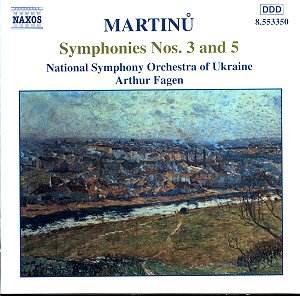
# Serviceable Martinu from Ukraine
The Martinu symphonies arrived late—the First not until 1942, when the composer had already crossed fifty and was living in wartime America, having fled the Nazi occupation of his homeland. Koussevitzky commissioned it for Boston. Once started, though, Martinu couldn’t stop. Five symphonies in five years, then a sixth to cap things off.
This is workmanlike stuff from Arthur Fagen and the National Symphony Orchestra of Ukraine, recorded back in 1995 in Kiev. Workmanlike—I use the word deliberately. The playing has discipline, even a certain spirit in the louder passages. The strings produce that characteristic Martinu shimmer in the Fifth’s more luminous moments. But something’s missing.
What’s missing is that particular urgency, that sense of driven necessity that makes these symphonies more than well-constructed neoclassical exercises. The Third especially—written when the war’s outcome was still very much in doubt—contains passages of real anguish. Fagen acknowledges this. He shapes the phrases correctly, observes the dynamic contrasts. The orchestra follows competently. Yet the interpretation never quite blazes.
Take the opening of the Third. Those propulsive ostinatos in the strings should create genuine anxiety, not just rhythmic activity. The brass chorale that emerges needs more weight, more darkness of tone. Here it sounds merely loud rather than tragic. The Ukraine brass section plays accurately but without the burnished richness that Czech orchestras bring to this music—and make no mistake, that matters. Martinu’s orchestration, for all its sophistication, was conceived with specific timbres in mind.
The Fifth fares somewhat better. Its more optimistic character—that extraordinary radiance Martinu achieved in the final movement—comes through clearly enough. The recording captures the spatial effects nicely, those antiphonal exchanges between string sections that create such distinctive textures. But again: compare this to Bryden Thomson’s Chandos release with the Royal Scottish National Orchestra, if you can still find it, and you hear the difference immediately. Thomson’s strings sing. These merely play.
The recorded sound itself is truthful, as the original reviewer noted. Not spectacular, not quite first-rank, but perfectly adequate. The Grand Studio of Ukraine National Radio provides decent acoustics, though the string sound lacks the last degree of bloom and the brass can turn a bit harsh in fortissimos.
I keep coming back to Jiří Bělohlávek’s Czech recordings—not because of nationalism or authenticity fetishism, but because those performances understand something essential about Martinu’s idiom. The way Czech orchestras shape those asymmetrical phrases, the natural feel for the folk elements embedded in even these most cosmopolitan scores… it’s not something you can learn from a score alone.
Still. For budget-conscious collectors exploring Martinu’s symphonic output, this Naxos disc serves a purpose. Both works are represented complete and correct. The performances never embarrass. They simply don’t illuminate—and with a composer still fighting for repertory recognition, that’s perhaps not quite enough. Better to save up for Thomson, or investigate the various Czech options. Martinu deserves more than competence.