
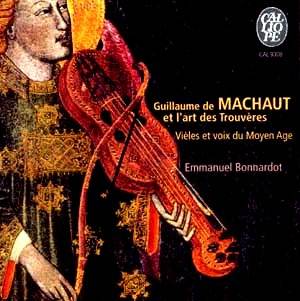
Machaut and the Trouvères: A Misleading Title for an Otherwise Captivating Journey
Guillaume de Machaut et l’art des Trouvères
Emmanuel Bonnardot and ensemble
Calliope 9308 [67:41]
The title here is something of a bait-and-switch. Guillaume de Machaut, that towering figure who bridged ars antiqua and ars nova, appears only in the final two tracks of this generous program. One might reasonably feel duped—except that what Emmanuel Bonnardot and his colleagues have assembled turns out to be so consistently absorbing that quibbling about nomenclature seems churlish.
This is trouvère music, mostly anonymous or attributed to figures like Gace Brulé, Colin Muset, and Adam de la Halle. The instrumental forces center on bowed strings—vielles, rebecs, the wonderfully nasal crwth—with Hélène Moreau’s psaltery adding its crystalline commentary. Bonnardot himself takes the vocal lines, and his voice possesses that earthy, slightly weathered quality that sidesteps the precious falsetto approach too many early music singers adopt for this repertoire. He sounds like someone who might actually have sung these chansons in a medieval hall, not a conservatory seminar room.
The program’s architecture shows real intelligence. “La quarte estampie roial” opens with five vielles and rebecs in full cry—that characteristic medieval drone establishing itself before the melody begins its sinuous, almost hypnotic patterns. The oriental inflections are unmistakable, reminders of Crusader contact with Arabic musical culture. Then Gautier de Coincy’s “Ma vièle vièler veut un biau son” adds voice to the instrumental texture, and you hear how naturally these performers move between purely instrumental and vocal-instrumental idioms.
I was particularly struck by the motet “L’autrier joer m’en alai,” where Bonnardot’s voice intertwines with crwth and two vielles in a texture that manages to sound both archaic and oddly fresh. The tuning isn’t always pristine—medieval pitch standards being what they were (or weren’t)—but the slight roughness feels appropriate, even necessary. This isn’t music that benefits from excessive polish.
The polyphonic pieces reveal the ensemble’s technical command. Adam de la Halle’s “Fi maris” for three voices reveals clean part-writing and good blend, though I wished for slightly more rhythmic spring in the delivery. The instrumental “Li dous regars” that follows makes an effective contrast, the three vielles negotiating their interlocking lines with appealing clarity.
When Machaut finally appears, it’s worth the wait. “Le lay mortel” receives a genuinely moving reading, Bonnardot’s voice supported by crwth and psaltery in what amounts to nearly ten minutes of sustained medieval melancholy. The lai form—those multiple strophes with their subtle variations—can turn static in less imaginative hands, but here the performers find the dramatic arc within the apparent repetition. The oriental melodic contours that Kirk McElhearn noted in his original review are indeed present, those sinuous arabesques that suggest how cosmopolitan fourteenth-century French court culture actually was.
The disc itself, made in the Église de Sergines, provides just enough resonance without turning everything into sonic fog. You can hear the individual timbres of these instruments—the reedy intensity of the rebec, the deeper warmth of the vielle, the percussive attack of the bowed citole.
Should Calliope have titled this disc more accurately? Probably. Does it matter once you’re listening? Not really. This is first-rate medieval music-making, informed by scholarship but never enslaved to it, performed by musicians who understand that even seven-hundred-year-old music needs to breathe and pulse. The Machaut may be minimal, but the artistry is substantial throughout.
Richard Dyer
