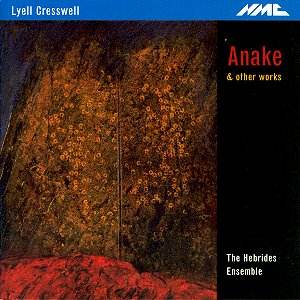
Lyell CRESSWELL (b. 1944)
Whira (1996) • Atta (1993) • Anake (1998) • Acquerello (1998) • Variations on a Theme by Charles Ives (1987)
The Hebrides Ensemble: Daniel Bell (violin), William Conway (cello), Rosemary Elliott (flute), Peter Evans (piano)
Recorded December 2000, Reid Hall, Edinburgh University
NMC D 077 [73:20]
Lyell Cresswell’s music—if you’re not already familiar—resists easy pigeonholing. It is at once direct and enigmatic, spare yet intensely expressive, and this disc encapsulates that paradox beautifully.
The collection, devoted largely to chamber works written across the 1990s, reveals a composer — deeply attuned to the intimate textures and colours of solo and small ensemble writing. That these pieces avoid virtuosic pyrotechnics—though technical demands are by no means negligible—makes their communicative power all the more striking. Whira (‘violin’ in Maori), a substantial solo violin work in seven movements — opens the programme.
Immediately one notices Cresswell’s refusal to indulge mere display; instead, he conjures a palette of sonorities that range from biting spiccato to the warm, singing cantilena of the slow sections. The central ‘Burla’, a nod to Douglas Lilburn, is a clever balancing act—light, almost jocular, yet underpinned by an affectionate solemnity. The violin’s voice here is alive with subtle shifts in articulation and colour, drawing the listener close.
The recorded sound, dry and immediate, captures every scrape and whisper of the bow—details too often lost in more reverberant halls. Contrast this with Atta, a solo cello piece in eight sharply etched sections inspired by the Italian painter Maurizio Bottarelli. The cello here is less a singing instrument and more a storyteller, its narrative fractured and restless.
Each movement explores a distinct technical approach—double stops, sul ponticello, percussive pizzicato—yet all these gestures serve an expressive whole rather than a catalogue of effects. The cello’s resonance fills the space without ever becoming indulgent; Conway’s command is — palpable, especially in the sudden bursts of raw intensity that punctuate quieter moments. Anake (‘alone’ in Maori), from 1998, is a shorter, three-movement work for solo flute.
Here, Cresswell’s lyricism is more overt, particularly in the final lament inspired by Garcia Lorca’s Llanto por Ignacio Sánchez Mejías. The opening movement juxtaposes fragmentary motifs with flowing lines, as though the flute’s breath itself contends with memory and silence. The "scherzo" middle section dances with rhythmic irregularities that feel spontaneous rather than contrived.
Rosemary Elliott’s playing breathes life into these contrasts, with an almost vocal inflection in the melodic arcs. Little Acquerello, a piano miniature also from 1998, is a gem of concision and colour. Evans’s touch is crisp but never brittle, allowing the piece’s shimmering textures to sparkle without losing their warmth.
It’s an ideal encore piece—brief but lingering, like a sudden glimpse of sunlight through autumn leaves. The set closes with Variations on a Theme by Charles Ives for flute and cello, composed in 1987. Cresswell’s relationship with Ives is fascinating—he neither imitates nor parodies but rather pays affectionate homage.
The theme, drawn from Ives’s Songs my Mother Taught Me, unfolds with a nostalgic tenderness. The twelve variations that follow are like reflections seen in a gently rippling pond: sometimes clear, sometimes distorted, but always deeply felt. It’s a rare instance where homage avoids cliché, offering instead a personal dialogue across time.
What ties these works together is Cresswell’s commitment to expressive clarity without succumbing to facile accessibility. His music often wears its complexity lightly, never demanding that we unravel every twist on first hearing, but rewarding sustained attention with melodic and harmonic riches that quietly accumulate. The performances here are sensitive and assured; the Hebrides Ensemble, and especially the soloists, navigate the subtle shifts in tempo and dynamics with admirable finesse, allowing the music’s intimate rhetoric to unfold naturally.
If there is a weakness, it might be the somewhat neutral production ambience, which—while transparent—occasionally leaves one — wishing for a touch more warmth or spatial depth, especially in the solo violin and cello works. Yet this is a minor quibble in an otherwise compelling package. In sum, this disc offers a welcome survey of Cresswell’s chamber oeuvre from the closing decade of the twentieth century, highlighting a composer whose music deserves wider recognition.
It is music both of and for the moment—intensely personal but not insular—crafted with care, insight, and a rare poise. One hopes this release will spur further explorations into his compelling catalog. Highly recommended.