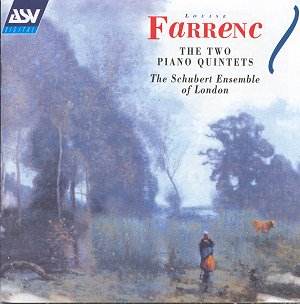
Louise Farrenc
Piano Quintet No. 1 in A minor, Op. 30 & No.
2 in E, Op. 31
Schubert Ensemble of London (William Howard, piano; Simon Blendis, violin; Douglas Paterson, viola; Jane Salmon, cello; Peter Buckike, double bass)
Recorded Potton Hall, Suffolk, February 8–10, 2001
ASV CDDCA1122 [59’26”] [DDD]
It’s tantalising how the music of Louise Farrenc — a figure still, regrettably, on the margins — manages to feel both anachronistic and thrillingly fresh at once. These two piano quintets, recorded by the Schubert Ensemble of London, arrive as invitations: to reconsider a composer whose work has long been overshadowed by contemporaries yet who clearly deserves a much wider hearing.
The First Quintet in A minor, Op. 30, written in 1829, immediately reveals Farrenc’s command of classical form tempered with Romantic impulse. The opening "Allegro" is framed by an "Andante" sostenuto introduction — surprisingly expansive and — well — almost contemplative rather than stormy — setting a mood that teases but never threatens.
The piano-writing here is neither showy nor timid; it balances lyrical lines with a robust rhythmic drive, especially palpable in the "Scherzo". That movement, a vivacious romp with a Trio that positively bursts with buoyancy, showcases the ensemble’s razor-sharp articulation and ensemble cohesion. You hear every staccato thrust and lightly sprung bow stroke — these players don’t merely perform the notes; they inhabit the music’s kinetic energy.
Jane Salmon’s cello work particularly stands out in the "Adagio" non troppo, where the rich timbre of the instrument melts into the piano’s warm chordal underpinnings. Here Farrenc’s imagination seems most unfettered — textures weave together — the harmonic language flirting with chromaticism but never losing its classical poise. The result is a movement that feels intimate, almost confessional, yet retains structural clarity.
This is chamber music that breathes. One might pause to note the unusual quintet scoring — the presence of double bass rather than a second violin, which lends these works a sonority darker, more grounded than the standard piano quintet configuration. Peter Buckike’s contribution is subtle but crucial; the bass underpins without overwhelming, weaving with Douglas Paterson’s viola and Simon Blendis’s violin to create a rich palette that supports the piano rather than competes with it.
This texture allows Farrenc’s harmonic language to unfold with a marked sense of spaciousness. Turning to the Second Quintet in E, Op. 31, from 1830 — the composer continues her exploration with a buoyancy and grace that is utterly winning.
The "Allegro" grazioso that follows the slow introduction pulses with a lightness that nevertheless conceals a complex interweaving of voices. The slow movement, Grave, is a poignant contrast — delicately etched, every phrase weighed with expressive resonance. The last movement — positively effervescent — surges forward with joyous energy, its rhythms crisp and infectious.
No small credit is due to the Schubert Ensemble’s interpretation. Their blend of precision and — well — warmth prevents any dryness, a pitfall for a release that might otherwise feel scholarly but sterile. Here, every phrase is shaped with careful attention to dynamic shading and — well — tempi that breathe naturally — not forced into anachronistic rigidity, nor given to overblown Romanticism.
The recording quality itself deserves mention: clean, immediate, allowing each instrumental colour to shine through without artificial gloss. Farrenc studied with towering figures — Reicha, Hummel, Moscheles — and her work reveals that formidable lineage, yet with a personal voice that is both refined and direct. Her tenure as a professor at the Paris Conservatoire for more than three decades, and the admiration she garnered from Schumann and Berlioz, remind us that she was no minor talent.
If these quintets convince, the natural next step is her symphonies — which share the same freshness and inventive spark — and the wealth of chamber and solo piano works still awaiting rediscovery. Farrenc’s music here is luminous, enchanting, full of subtle surprises and emotional sincerity. The Schubert Ensemble of London’s performances remind us why such music deserves a permanent place in the repertoire, not merely as historical curiosity but as living, breathing art.
Highly recommended — a disc that rewards repeated listening and invites a reappraisal long overdue.