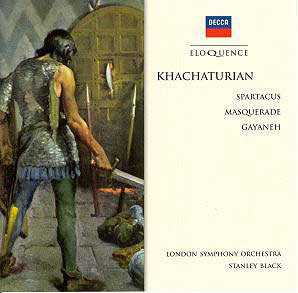
Aram Khachaturyan (1903–1978)
Spartacus Suite (1956) [21:31]
Masquerade Suite (1941) [17:09]
Gayaneh Suite (1943) [18:41]
London Symphony Orchestra, Stanley Black
Recorded 1975, 1978 (ADD)
Decca Eloquence 461 007-2 [68:47]
Some recordings are time capsules, capturing more than just the notes: they echo an era’s aesthetic, technological quirks, even a leader’s particular cinematic sensibility. Stanley Black’s recordings of Khachaturyan’s suites, originally laid down in the mid-’70s and now resurrected on Decca’s Eloquence imprint, are such an artifact—both a blessing and a mild frustration. The Spartacus Suite’s "Adagio" for Spartacus and Phrygia is possibly Khachaturyan’s most famous melody, partly thanks to the BBC’s The Onedin Line.
Here, Black’s reading is expansive, almost luxuriantly so, bathing the noble theme in a rich, velvety Phase Four sound that’s a little of its time but still surprisingly affecting. The strings swell with a warmth that borders on indulgence, the harp shimmering almost seductively beneath them. But—and this is key—this lushness comes at a cost: the clarity and shimmering edge one finds in the original BMG-Melodiya recordings, where the composer’s own conducting affords a slightly leaner, more elemental pulse, are somewhat softened here.
Black’s interpretation is less about the primal tension and more about broad romantic gestures, which might leave those craving rawer intensity a little wanting. Yet Black’s treatment of the Dance of the Gaditanes is a triumph of atmosphere. The Bolero-like ostinato pulsates with undercurrents of fiery Spanish heat.
The London Symphony Band, with its famously opulent string section, sustains an almost palpable tension throughout, the brass interjections glittering sharply without overwhelming the texture. It’s a balancing act—on the razor’s edge between sensual abandon and disciplined precision—and here, Black pulls it off with aplomb. Moving to the Masquerade Suite, one encounters a different beast altogether.
It’s a riotous, carnival-like affair, full of the wild, sometimes clumsy charm that Soviet-era exoticism so often carried. Black’s approach here is surprisingly restrained compared to other conductors like Svetlanov or Tjeknavorian, — whose versions can feel like a kaleidoscope spun too fast—too much color, too little form. Here, the suite’s five movements unfold with a controlled cheekiness: the Mazurka in particular crackles with a brassy, almost cheeky vitality.
It’s a “vulgar steely borscht” of Offenbach’s can-can and Parisian café-concert esprit, executed with just enough polish to keep it from descending into mere caricature. Black’s hands bring out the dance rhythms’ infectious energy, without blurring the orchestral detail. Gayaneh is perhaps the most uneven of the three suites — but its charms are undeniable.
This suite, mined from Khachaturyan’s ballet score, wears its influences—Borodin’s Prince Igor, Ippolitov-Ivanov’s Sardar; March, Shostakovich’s shadow, and the lush colorism of Rimsky-Korsakov’s Russian Easter Festival—on its sleeve. Yet the Dance of the Rose Maidens stands out as an exquisite miniature, a tender, almost hypnotic jewel in the score’s crown. Black’s LSO crafts it with a supple lyricism that hints at Mussorgsky’s “Dance of the Persian Slaves” from Khovanshchina, yet never slides into pastiche.
The orchestral textures here are finely chiseled, with the woodwinds and — well — harp particularly well featured, creating a shimmering veil that’s both nostalgic and fresh. Khachaturyan’s music, often dismissed as “hokum” or primitivistic, reveals in these suites a composer deeply attuned to rhythmic vitality and melodic invention. Black’s readings soften the edges of Khachaturyan’s sometimes raw, muscular idiom—but the flipside is a smoother, more lyrical profile that will appeal to listeners who find Soviet bombast too much.
You can almost hear the rosin dust settling on the strings.
The LSO, in these sessions, is in top form, their lush strings and bright brass sections well captured in a sound that, while dated, still holds considerable charm. If these performances do not replace the composer’s own or later, more authentically “Russian” takes, they remain valuable documents—not least for their mid-70s English light-classical sensibility, which brings out a different, unexpectedly delightful facet of Khachaturyan’s scores. For those approaching these suites anew—especially the uninitiated—the Decca Eloquence release offers an inviting, if slightly romanticized, window onto music that remains a fascinating blend of exoticism and — well — earnestness.
In the end, this collection is less about fidelity to original intent and more about a distinctive interpretive voice—one that makes you listen differently, even if you ultimately reach for the sharper Melodiya alternatives afterward. But isn’t that, after all, partly the joy of recorded music? To hear a familiar work refracted through another’s sensibility, with all its idiosyncrasies and warmth intact.