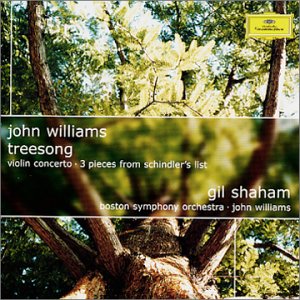
John Williams: Treesong; Violin Concerto; Three Pieces from Schindler’s List**
Gil Shaham, violin; Boston Symphony Orchestra/John Williams
DG 471 326–2 [66:05]
There’s something quietly radical about this disc—though you wouldn’t know it from the packaging, which bears all the glossy hallmarks of Deutsche Grammophon’s crossover aspirations. But listen past the surface, and what emerges is more substantial than anyone might reasonably expect from a film composer’s excursion into “serious” music.
Treesong, receiving its premiere album here, proves Williams can think in genuinely symphonic terms when he wants to. The work grew from the composer’s fascination with a Dawn Redwood in Boston’s Public Garden—a tree planted by the Chinese botanist Shiu-Ying Hu, whom Williams later met by chance. That backstory could easily have yielded something merely picturesque, the musical equivalent of a coffee-table book. Instead, Williams has written a twenty-minute tone poem of real substance, inverting the conventional concerto structure (slow-fast-slow) and sustaining an atmosphere of contemplative mystery that never quite dissipates.
The opening movement, “Doctor Hu and the Metasequoia,” unfolds with a dreamlike continuity—Shaham’s line floating above orchestral textures that shimmer and shift like dappled light through leaves. Williams has learned from Debussy, certainly, but also from his film-music palette: those string harmonics create an iridescent wash of color that’s unmistakably his. The second movement accelerates into something more graphic, depicting the tree’s growth with athletic vigor, though it never quite escapes a certain episodic quality. What rescues the structure is the cadenza Williams wrote to bridge into the "finale"—a long-breathed meditation that gives Shaham room to simply sing, his tone pure as spring water.
“The Tree Sings” itself brings unexpected richness. The orchestration thickens, darkens; you hear Williams thinking orchestrally in ways his film scores rarely permit. There’s genuine development here, not just restatement, and the climax—when it arrives—feels earned rather than manufactured.
The Violin Concerto (1974–76, revised 1998) stakes larger claims. Williams acknowledges Bartók, Prokofiev, and Walton as models, and you hear all three ghosts hovering. The first movement balances lyrical expansiveness against motoric energy—sometimes awkwardly, the seams showing where Williams hasn’t quite achieved organic flow. But the slow movement, marked “in peaceful contemplation,” achieves genuine eloquence. Shaham plays it with an inwardness that makes you forget the technical difficulties, though they’re considerable.
The "finale" bursts forth with the kind of athletic brilliance that recalls Walton’s concerto, though Williams’s harmonic language remains more conservative. Shaham dispatches the double-stops and left-hand pizzicatos with nonchalant security—his intonation remains flawless even in the most exposed passages, his tone never turning steely under pressure. One wishes Williams had taken more harmonic risks here; the closing pages, for all their surface excitement, don’t quite deliver the emotional knockout they promise.
The Three Pieces from Schindler’s List function as encore—a calculated move to end with Williams’s most famous “serious” music. Shaham plays with aching simplicity, resisting the temptation to sentimentalize. The theme itself, which has become almost too familiar, recovers some of its original poignancy in this context, stripped of its cinematic associations. “Jewish Town (Kraków Ghetto—Winter ‘41)” employs klezmer-inflected figures that Williams handles with surprising restraint, while “Remembrances” circles back to the opening theme, now shadowed by deeper knowledge.
Throughout, the Boston Symphony plays with an intimacy born of long association—Williams conducted these sessions himself, and the orchestra responds with a warmth and precision that would do credit to any repertoire. The recorded sound captures the Symphony Hall acoustic with pleasing clarity, though the violin placement is sometimes too forward for comfort, particularly in the concerto’s first movement.
What to make of Williams as a “classical” composer? The question itself feels increasingly irrelevant. These aren’t works trying to pass as something they’re not; Williams writes in a tonal idiom enriched by film-music techniques—lush orchestration, immediate melodic appeal, cinematic pacing—but shaped by genuine symphonic thinking. Treesong in particular suggests what might happen if we stopped policing the boundaries between “serious” and “popular” music and simply listened.
Will these works enter the standard repertoire? That’s harder to predict. The concerto faces stiff competition in an overcrowded field, and its stylistic conservatism may work against it in an age that values either radical innovation or unabashed Romanticism. But Treesong has a better chance—it’s distinctive, beautifully crafted, and gives a great violinist something genuinely interesting to say.
Shaham’s advocacy makes the crucial difference. His playing combines technical security with expressive warmth, never condescending to this music or overselling it. He believes in what he’s playing, and that conviction proves contagious. This is musicmaking of real integrity—and that, finally, matters more than questions of genre or pedigree.