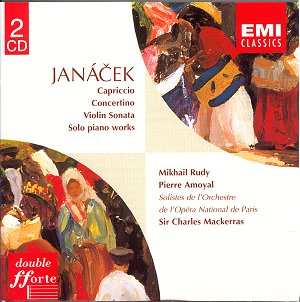
Janáček: Piano and Chamber Works
Mikhail Rudy, piano; Gary Hoffman, cello; Pierre Amoyal, violin; Soloists from l’Orchestre de l’Opéra National de Paris/Sir Charles Mackerras
EMI 7243 5 74843 2 9 (2 CDs, 151:21)
This sprawling double-disc set—recorded at different times, in different venues, presumably assembled from what was available in the EMI vaults—presents an oddly wide-ranging yet thoroughly persuasive survey of Janáček’s output for piano, both solo and in various combinations. Mikhail Rudy anchors everything here, and the question one keeps returning to is simple enough: can a non-Czech pianist really penetrate this most Czech of composers?
The answer, it turns out, is yes. But not without cost, not without trade-offs.
Rudy’s approach to the solo works reveals itself immediately in 1. X. 1905. Where Firkušný—and one cannot discuss recorded Janáček without invoking that name—attacks the octaves in “The Presentiment” with almost brutal directness, the angular syncopations snapping like winter branches, Rudy finds something more inward, more hesitant. His touch in the left-hand ostinato is rounder, less percussive. The famous climax arrives not as explosion but as reluctant confession. It’s deeply personal playing, though whether it’s authentically Janáčekian is another matter entirely.
On the Overgrown Path benefits enormously from this introspective quality. These miniatures—deceptively simple on the page, devilishly difficult to characterize in interpretation—need the kind of timbral subtlety Rudy commands. Listen to how he voices the inner lines in “A Blown-Away Leaf,” the way the middle register emerges like memory itself, indistinct yet insistent. The pedaling throughout is masterful, creating those characteristic Janáček hazes without ever turning muddy.
But then there’s In the Mists, and here I confess to reservations. This four-movement cycle demands a certain hallucinatory quality, a sense of psychological dislocation that Rudy’s essentially lyric temperament doesn’t quite encompass. The third movement, with its obsessive repetitions and harmonic dead-ends, should feel more disturbing than it does here. Firkušný made you feel the ground shifting beneath your feet; Rudy keeps you safely on solid earth, even when the score suggests quicksand.
The chamber works reveal different strengths. Gary Hoffman brings a gorgeous, burnished tone to Pohádka, though I wish he’d allow himself more of the gypsy wildness that lurks in these pages. The opening “Con moto” wants more abandon, more risk—Hoffman is almost too refined. Yet the slow movement, that extraordinary meditation, finds both artists at their considerable best. The cello’s long-breathed phrases float over Rudy’s refined accompanying figures with real magic, and the final pages, marked morendo, genuinely die away into silence rather than merely getting soft.
Pierre Amoyal in the Violin Sonata proves a more volatile partner, and the results are correspondingly more exciting. His vibrato has bite, his attacks real edge. The “Ballada” second movement—one of Janáček’s strangest inspirations, folk music refracted through modernist anxiety—emerges with the proper unsettled quality. Rudy responds in kind, his accompaniment more angular, more responsive to the violin’s mercurial shifts of mood.
Mackerras conducting the Capriccio and Concertino is, predictably, superb. These odd hybrids—not quite chamber music, not quite concertos—need a director who understands Janáček’s orchestral thinking from the inside, and Mackerras certainly does. The winds from the Opéra National play with real character, especially the horn in the Concertino‘s outer movements. Rudy holds his own against these strong personalities, though the recorded balance occasionally favors the orchestra more than ideal.
The Concertino receives a particularly fine reading. Mackerras shapes the first movement’s strange modal progressions with absolute clarity—you hear the music’s folk origins and its modernist transformation simultaneously. The central “Più mosso” has the right headlong quality, piano and orchestra locked in genuine dialogue rather than mere alternation. And that final movement, with its almost obsessive return to the opening material, builds to a conclusion that feels both inevitable and surprising.
Technical points: the 1990 recordings (made at the Église du Liban) sound warmer, more spacious than the 1995 sessions at the Salle Ravel, which are drier, more immediate. Not a fatal discrepancy, but noticeable when moving between discs. EMI’s documentation is adequate—no texts for On the Overgrown Path, but useful notes by Harry Halbreich.
So where does this leave us? Rudy is unquestionably a Janáček interpreter of real accomplishment, even if his sensibility runs counter to the composer’s in certain fundamental ways. His lyricism, his preference for introspection over extroversion, his essentially Western European sound world—these shape performances that are convincing on their own terms without necessarily being definitive.
For listeners who find Firkušný too uncompromising, too severe, Rudy offers a genuine alternative. For those who believe Janáček’s music demands precisely that severity, that refusal to beautify or soften, this set will seem well-played but somehow beside the point.
I find myself, finally, in the middle. Strongly recommended, yes—but with the understanding that other truths about this music exist, perhaps deeper ones.