Herbert Howells
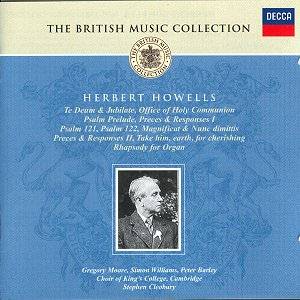
Te Deum & Jubilate, Office of Holy Communion, Psalm Prelude, Op. 32 No. 2, Preces & Responses I & II, Psalm 121, Psalm 122, Magnificat & Nunc Dimittis, “Take Him, Earth, for Cherishing”, Rhapsody for organ, Op.
17 No. 3
Gregory Moore (cantor), Simon Williams (tenor), Peter Barley (organ)
Choir of King’s College, Cambridge / Stephen Cleobury
Recorded 1989 | Decca DECCA 470 194 2 [78:28]
Reissued as part of Decca’s British Music Collection (midprice)
The slow, luminous unfolding of Howells’s religious choral works here—drawn from the heart of his sacred output—feels both intimate and, paradoxically, grandly architectural. This Decca reissue, a gem recorded under Stephen Cleobury’s direction with the King’s College choir, offers a rare immersion; into the composer’s ecclesiastical sound world, one that is drenched in Anglican mysticism but never cloistered within mere liturgical function.
Right away, what strikes you is the warmth of the choir’s tone—rounded, but with just enough clarity to let harmonic tensions bloom without ever becoming opaque. Howells’s harmonic palette is, after all, a subtle loom of modal inflections and — well — sudden chromatic turns that demand a certain nimbleness: the singers here thread those twists with remarkable poise. The “Office of Holy Communion” movements—particularly the Te Deum and Jubilate—proceed with measured solemnity, their phrases punctuated by subtle suspensions and carefully calibrated dynamic swells that Cleobury teases out with almost conversational phrasing.
You can almost hear the rosin dust settling on the strings.
Peter Barley’s organ playing deserves special mention. His approach to the Rhapsody, Op. 17 No.
3 is both imaginative and restrained—a careful balance between the work’s inherent drama and the organ’s resonant power. Barley’s registrations glow amber rather than blaze; his pedal work is measured, avoiding the temptation to dominate, instead conversing with the choir’s textures. In quieter passages, his touch is almost caressing, evoking a sensuous reverence that complements Howells’s harmonic language perfectly.
The motet “Take Him, Earth, for Cherishing” feels like the emotional climax here—a poignant elegy written in 1967, in response to the Kennedy assassination. It’s a work heavy with elegiac weight, and the choir’s delivery is soaked in understated grief. Yet sometimes one longs for a fuller, more robust choral presence to deepen the lament’s gravity.
Still, the delicacy of phrasing and the slow-build crescendo offer a authoritative, if somewhat reserved, expression of mourning. A minor quibble lies in the production’s booklet: sparse liner notes leave much unexplored, particularly surprising given Howells’s rich biographical and stylistic context. More insight would have augmented this listening experience, especially for those less familiar with the Anglican choral tradition’s nuances.
Listening to the Psalm Preludes, such as Op. 32 No. 2, one hears the characteristic Howells blend of pastoral lyricism and sudden harmonic shifts that challenge the organist’s sensitivity.
Barley meets this challenge with aplomb, delivering a rendition full of subtle rhythmic inflections and a — keen sense of space—breathing room, one might say, that lets the music’s spiritual dimension come alive. This collection shines most in its consistency: rather than a scattershot compilation of isolated pieces, it offers a coherent portrait of Howells’s sacred idiom. The choir’s historical link to the composer’s intended venue—King’s College Chapel—imbues these performances with authenticity that few other ensembles could match.
The balance, the phrasing, the organic ebb and flow of sound: all speak of musicians who know this music “in their blood,” as the cliché goes, but here it’s palpably true. In sum, this Decca reissue is more than a mere archival curiosity. It’s an essential window into Howells’s choral mastery, capturing the fusion of subtle harmonic daring and devotional sincerity that defines his legacy.
For those seeking a thoughtfully curated, sensitively rendered introduction to Howells’s sacred music, this disc deserves a place near the top of the pile…. It’s not flawless—one might wish for a touch more vocal heft in places, or fuller scholarly context—but its virtues far outweigh its limitations. A recording to return to—time and again—for the quiet splendour of Howells’s quietly radiant musical faith.