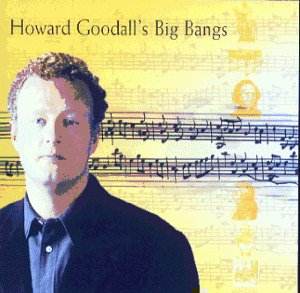
Howard Goodall: Big Bangs
Metronome MET CD 1043 [63:00] – various artists including Sumi Jo, Cecilia Bartoli, Siegfried Lorenz, Norman Shetler, Neville Creed, Bournemouth and Windsor Castle ensembles
Recorded: mixed dates, analogue and digital sources, incl. Christ Church Cathedral, Winchester Cathedral
A curious patchwork, this Big Bangs—part musical essay, part miscellany, part personal manifesto. It’s Howard Goodall’s brainchild, a recorded companion to his television series exploring five — seismic inventions in Western music: notation, opera, equal temperament, the piano, and production.
And — yes, the title is a bit of a pun, but before you snort, the concept has heft. It’s just that the execution feels… uneven, like a lecture that sometimes meanders into a pub conversation with a classical music obsessed friend.
The opening Miserere by Gregorio Allegri (Winchester Cathedral, conducted by Martin Neary) sets a high bar. Its ethereal treble lines shimmer with a certain tactile roughness—no silky, frictionless sheen here, which might irk purists used to the smoothest modern recordings. Instead you get a gently grainy analogue aura, the kind that situates you firmly in a medieval reverie.
The acoustic is cavernous but intimate, a paradox caught in the air. Contrast that with the Monteverdi excerpt from the 1610 Vespers recorded at Christ Church Cathedral. Digitally pristine but sonically enclosed, the ensemble’s delivery impresses less by expansiveness than by its scholarliness—the — voices articulate the ornaments crisply, yet the overall effect feels constrained, as if trapped behind glass.
Still, Sumi Jo and — well — Cecilia Bartoli’s contributions in the Mozart Pace, pace from Marriage of Figaro restore some needed vitality. They don’t merely sing; they inhabit the drama, Bartoli’s mezzo cutting through with agile coloratura, Jo’s soprano a shimmering foil. The male voices, while less distinguished, provide a solid foil.
Then, quite abruptly, we drop into John Dunstaple’s Veni Sancte Spiritus, here arranged by Goodall for three male voices. It’s a mood shift—cool, austere, and stark, which is perhaps the point, but the juxtaposition with the preceding flourish feels jarring, almost disjointed. Goodall’s own Agincourt Song—a brief, 42-second concoction—is a curious hybrid: part medieval pastiche, part modern percussion-driven folk tune.
You might think of it as a “Blondel meets Ulster drums” experiment. It’s idiosyncratic, if not entirely seamless. The Bach Prelude and Fugue No.
1 from The Well-Tempered Clavier in Pischner’s hands bursts somewhat forward in the mix—raw, almost uncomfortably immediate. It’s a execution that wears its muscularity on its sleeve, lacking the usual polish but compensating with urgency. This is Bach without the velvet glove, if you will.
Goodall’s arrangement of Schubert’s “Gute Nacht” from Winterreise offers a glimpse into his populist instincts—a pop ballad style English translation sung with approachable clarity. Then the German original follows, perfomed by Siegfried Lorenz with Norman Shetler’s sensitive piano, delivering the haunting melancholy of Schubert’s masterpiece in full. The disc then stumbles stylistically to Scott Joplin’s “Maple Leaf Rag” and leaps further to Caruso’s sonorous — “Vesti la Giubba” from I Pagliacci, a reminder of the century-spanning tastes at play here—almost a musical rollercoaster.
David Fanshawe’s African Sanctus—a landmark fusion of Western choral and African traditional music—gets a vigorous outing from Neville Creed and the Bournemouth and Windsor Castle ensembles. The polyrhythmic energy and drum-driven propulsion are palpable, capturing the work’s tension between sacred and secular, old and new, much as intended. Goodall’s own Sanctus from Missa Aedis Christi (1992) emerges as a genuine revelation.
Composed during a stay in Embrun, France, it vibrates with the sonic imprint of the village’s evening bells. There’s a certain chaotic, ecstatic abandon in the choral textures that evoke both a rustic; ritual and a towering symphonic climax—a quality reminiscent, oddly enough, of Hilding Rosenberg’s Johannes Uppenbarelse. This piece alone merits wider attention and suggests that Goodall’s compositional voice is more substantial than his media persona might imply.
The disc closes—somewhat predictably—with Strauss’s Im Abendrot from Four Last Songs, led by Hanne-Lore Kuhse and the Gewandhaus Orchestra under Vaclav Neumann. It’s a serviceable but earthbound reading; the balance favors the band too heavily, and — the vocal line never quite manages to soar with the transcendent release one expects here. The performance feels cautious where it should be radiant.
So what to make of Big Bangs overall? It’s a miscellany, yes, but one with flashes of insight and moments of real beauty. A listener coming in fresh—without the context of the TV series—might find the disc’s eclecticism a bit bewildering, the transitions abrupt and the sonic palette uneven.
Yet it’s precisely this patchwork nature that reflects the theme of seismic shifts in music history: sudden ruptures, revolutionary ideas exploding into new forms. Goodall’s dual role as educator and composer shines through—he wears his enthusiasm on his sleeve and isn’t afraid of stylistic collisions. Ultimately, Big Bangs is less a polished anthology than a spirited conversation with classical music’s landmark inventions and their living legacy.
It may not stand entirely on its own as a listening experience, but it rewards those curious enough to embrace its quirky jumps and vernacular charm. And in that, the disc’s greatest triumph is Goodall’s Sanctus—a work that might just be waiting for discovery beyond this curious confederation of sound.