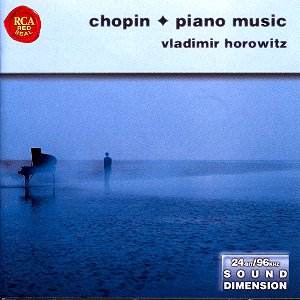
Chopin: Polonaise-fantaisie, op. 61; Ballade no. 1, op. 23; Nocturnes; Barcarolle, op. 60; Études; Ballade no. 4, op. 52; Valse, op. 69, no. 1
Vladimir Horowitz, piano.
RCA Red Seal 74321 68008 2. Recorded 1957–82. Compact disc, 73:34.
Horowitz at the Edge: Late Chopin Performances That Both Dazzle and Disturb
What do we do with a genius in his late years who has stopped playing by the rules—even his own? This disc presents a problem, a fascinating one perhaps, but a problem nonetheless. BMG has assembled Horowitz’s Chopin recordings from various decades, and the chronological scatter tells a story that isn’t always comfortable to hear.
The 1982 Polonaise-fantaisie is perverse. There’s no other word for it. Yes, the disc captures a warmth, an almost tangible resonance in the bass that makes certain phrases—that hushed section just before the return, for instance—sound as though Chopin were whispering confidences. But the performance itself? Horowitz seems determined to prove that every note contains hidden possibilities, even if excavating them means dynamiting the surrounding architecture. Hands drift apart like continents. Single notes leap out with an almost violent “Look at me!” quality.
Here’s the thing: some of these sonorities are extraordinary. The way he voices that descending chromatic passage in the development—each note blooming separately yet somehow connected—would make any pianist weep with envy. But should he actually do all these things? The overall line suffers terribly. The noble sweep of this work, its architectural grandeur, gets sacrificed to momentary whims. His CBS recording from roughly 1972 contains most of these insights but keeps them in proportion, serving Chopin rather than Horowitz’s ego.
The G Minor Ballade sounds tired. Worse than that—it sounds automatic. The gestures are all there, the famous Horowitz touches, but the involvement isn’t. This is a warhorse he’s ridden too often, and both horse and rider need a rest. His 1968 Carnegie Hall rendition (on CBS) has an immediacy, a sense of discovery that’s entirely absent here.
Then we plunge backward to 1957 for the Nocturnes, and it’s like entering a different universe. The sound is dry, rather shallow—typical RCA from that era—but the playing is impeccable. These are “correct” performances, which might sound like faint praise except that correctness at this level means profound understanding held in perfect balance with technical mastery. The E-flat Nocturne, op. 9, no. 2, avoids the treacle that lesser pianists pour over it; the C-sharp Minor, op. 27, no. 1, has genuine tragic weight without melodrama.
Now the disc gets interesting again. The Barcarolle—from when, exactly? The annotation doesn’t say, but it sounds relatively late—is glorious. Not just in the sonic opulence (the recording team really captured the instrument’s bloom here) but in its evocation of Venice itself. I know that sounds fanciful, but no other performance I’ve heard so completely suggests water lapping against stone, sunlight fracturing on the lagoon’s surface. The rocking motion never becomes mechanical; it breathes.
The C-sharp Minor Étude, op. 25, no. 7—Chopin’s astonishing anticipation of Scriabin’s harmonic world—gets a performance of remarkable contrapuntal clarity. Those singing lines emerge with complete independence while the pulsating chords maintain their disciplined framework. This is Horowitz at his best: illuminating the music rather than decorating it.
The F Minor Ballade, that late work which has defeated so many great pianists (even Rubinstein never quite solved it), receives a performance of overwhelming cumulative power. The overall surge is perfectly judged, the conclusion shattering, and along the way there’s poetry in abundance—that wistful second theme, for instance, with its strange mixture of sweetness and foreboding. This alone is worth the price of admission.
Less successful is the Black Key Étude, op. 10, no. 5, which Horowitz apparently never found much poetry in. Comparing this to his earlier CBS version suggests he always treated it as pure mechanism—brilliant mechanism, admittedly, but missing the dreamy quality the piece can have. The A-flat Valse, though, is full of teasing rubato, those little hesitations and rushes that threaten to topple the whole structure but never quite do. It’s like watching a tightrope walker who makes you gasp but never falls.
So what’s the verdict? BMG’s presentation is baffling. The liner notes seem aimed at first-time buyers (“Chopin is for you!”), but what first-timer needs to hear the 1982 aberrations? Piano specialists probably already own these performances in the various Horowitz editions that have flooded the market. And yet—that Barcarolle, that Fourth Ballade—these are essential Horowitz, essential Chopin.
If you’re building a Chopin library from scratch, look to Rubinstein first (though heaven knows those compilations must have reached saturation point by now). If you’re a Horowitz completist, you already have this material. But if you’re a piano buff who somehow missed these particular performances of the Barcarolle and the F Minor Ballade, get them. Just be prepared to skip over some tracks—the price we pay for genius in its twilight, still capable of miracles but no longer reliably so.