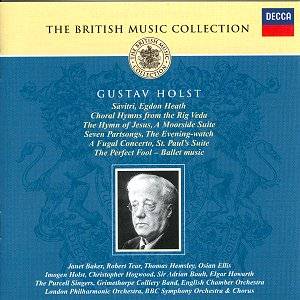
Gustav Holst (1874–1934):
Choral Hymns from the Rig Veda, Savitri, Seven Partsongs, The Evening Watch, Fugal Concerto, St Paul’s Suite, Ballet Music: The Perfect Fool, Egdon Heath, The Hymn of Jesus, Moorside Suite
Purcell Singers / Osian Ellis (harp) / Imogen Holst / Janet Baker (mezzo) / Robert Tear (tenor) / Thomas Hemsley (baritone) / English Chamber Orchestra / St Paul Chamber Orchestra / London Philharmonic Orchestra / BBC Symphony Orchestra / Grimethorpe Colliery Band
Conductors: Imogen Holst, Sir Adrian Boult, Christopher Hogwood, Elgar Howarth
Decca British Music Collection 470 191 2 [2 CDs: 149:30]
Recorded 1961–1992; reissued 2002 (Decca)
Budget price: Crotchet £12.95 / Amazon UK £11.99 / Amazon US £11.99
To think that Holst’s legacy is often pigeonholed by the cosmic sweep of The Planets is a mistake warranting correction. This generous two-CD Decca set, culled from recordings spanning over three decades, restores some balance to the picture — a mosaic of sonic colors and textures revealing the breadth of a composer too often eclipsed by his own celestial fame. Right away, the opening strains of the Ballet Music from The Perfect Fool kick in with invigorating zest.
The London Philharmonic under Sir Adrian Boult is crisp and muscular here—the rhythmic propulsion, especially in the outer movements, crackles with a vibrant, almost theatrical energy. You hear the unmistakable sweep of Holst’s orchestral palette: fluttering woodwinds, brassy outbursts, and a harpist—the lovely Osian Ellis—adding shimmering arabesques that never feel tacked on but integral to the fabric. Then there’s Egdon Heath, Holst’s bleak, brooding tone poem inspired by Hardy’s Return of the Native.
This is the work where Holst’s musical language becomes more cryptic, less immediately alluring; the orchestration is dense, the textures layered with dark, earthy hues. Boult’s reading is judicious—never over-sentimental but deeply atmospheric, letting the music speak in its own slow, haunting way. It’s the kind of piece that doesn’t yield its secrets on first hearing, demanding patience but rewarding with a sense of brooding inevitability.
The vocal music, curated and conducted by Imogen Holst—his daughter and an authoritative interpreter of his works—offers a different facet of the composer’s artistry. The Choral Hymns from the Rig Veda and the Seven Partsongs are finely wrought examples of Holst’s fascination with Sanskrit texts and complex vocal textures. The Purcell Singers deliver these with clarity and devotion, though one senses that more recent recordings by the — Holst Singers under Stephen Layton achieve a more delicately balanced blend, especially in the interplay of inner voices.
Yet, the warmth and earnestness here are palpable and sincere. The jewel in this crown is undoubtedly Savitri, a chamber opera inspired by a Sanskrit legend, a rarity in English opera repertoire. Janet Baker’s mezzo is incandescent—her lines sing with an almost otherworldly ease, each phrase shaped with nuance and profound expressivity.
Robert Tear and Thomas Hemsley provide sterling support, while the English Chamber Orchestra under Imogen Holst’s baton weaves a subtle, intimate tapestry. The opera’s mystical atmosphere benefits from Holst’s learned approach to the source material—his knowledge of Sanskrit isn’t mere exoticism but a foundation from which the music organically grows. On the instrumental side, the St Paul’s Suite and the Fugal Concerto performed by; the St Paul Chamber Band under Christopher Hogwood bring a lighter, more straightforward brightness.
These performances are impeccably clean, though at times the phrasing leans towards efficiency rather than a lush, romantic warmth. The St Paul’s Suite especially sparkles with youthful vitality, its neoclassical charm illuminated by Hogwood’s crisp tempi and transparent textures. The Fugal Concerto showcases Holst’s contrapuntal craft but occasionally feels slightly clipped — perhaps a touch too disciplined for the music’s inherent lyricism.
Of course, no Holst collection would be complete without The Hymn of Jesus, arguably his spiritual masterpiece. Boult’s 1960s release, painstakingly remastered here, still holds its own — the BBC Symphony Orchestra and Chorus are caught in a glowing acoustic that envelops without overwhelming. The music flows in a single, compelling arc, from hushed meditation to glorious exultation, and — well — this execution negotiates those shifts with a rare command of balance and nuance.
The chorus’s diction is clear, the rhythmic vitality precise, and the orchestral colors vivid yet never flashy. Finally, the Moorside Suite performed by the Grimethorpe Colliery Band under Elgar Howarth — is a bracing reminder of Holst’s affinity for brass textures and folk-inspired melodies. It’s robust and earthy; a rare glimpse of the composer’s lighter, populist side that complements the more austere works presented here.
This Decca set is not without its flaws—some performances feel slightly dated, the engineering varies, and a few readings could benefit from a more adventurous tempo or warmer phrasing. But such imperfections do little to diminish the overall achievement: a fascinating snapshot of Holst’s multifaceted output, presented with care and respect. For those willing to push beyond The Planets‘ immediate allure, this collection offers rich; rewards—a portrait of a composer whose musical curiosity and cultural breadth resist easy categorization.
That particular brightness of period instruments catches the ear.
In short, it’s an essential addition for any serious listener of British music. If Holst was a man who painted with many brushes, this set is a palette full of his finest hues—sometimes shadowy, sometimes radiant, but always compelling. A fine reminder that the man was far more than just an astrologer with a hit parade.
— Verdict: A well-curated, deeply informative anthology that convincingly argues for Holst’s place — as a serious, versatile composer whose works deserve more than a passing nod. Highly recommended, with particular praise for Savitri, Egdon Heath, and The Hymn of Jesus.