
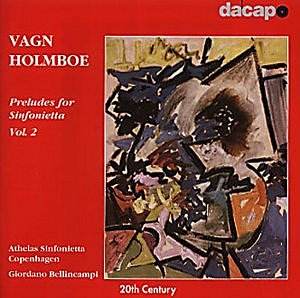
Holmboe’s Environmental Elegies
Vagn Holmboe’s final decade saw him turning—unexpectedly, perhaps—to nature. Not the Romantic sublime, mind you, but something more troubled, more contemporary. These Preludes for Sinfonietta, dedicated to Robert Layton (who championed Scandinavian music when few others bothered), carry titles like “To the Pollution of Nature” and “To the Seagulls and the Cormorants.” Programmatic? Not really. The music resists illustration even as it gestures toward its subjects.
Volume 2 completes the cycle begun on Dacapo 8.224134, offering the remaining five preludes plus two chamber works—the Sonata for Trombone and Piano and Music with Horn—to fill out the disc. The Athelas Sinfonietta Copenhagen, under Giordano Bellincampi, plays with the kind of lean precision this music demands. Holmboe’s textures are transparent, almost ascetic; every line matters.
“To the Calm Sea” opens with sustained winds that seem to hover rather than progress—a kind of stasis that’s harder to achieve than it sounds. The writing recalls Nielsen’s wind quintets, that same clear-eyed Nordic objectivity, though Holmboe’s harmonic language remains more astringent. When the strings enter, they don’t so much interrupt as infiltrate, creating a web of counterpoint that’s genuinely polyphonic rather than melody-plus-accompaniment. The interpretation captures this balance beautifully, though I’d have welcomed a bit more warmth in the string tone. The Lyngby Kapel acoustic provides clarity but perhaps too much clinical distance.
“To the Pollution of Nature” proves the most overtly dramatic of these pieces—agitated figurations, sudden dynamic contrasts, a genuine sense of disturbance. Yet Holmboe avoids anything resembling programmatic literalism. This isn’t Honegger’s Pacific 231 or even Vaughan Williams’s London traffic. The composer’s method, forged through decades of studying Romanian folk music (his Bartók connection runs deep), transforms environmental concern into abstract musical argument. The development sections proceed through what Holmboe called “metamorphosis“—thematic cells that evolve organically rather than being conventionally developed. You hear it most clearly in “To a Pine Tree,” where a simple ascending fourth generates nearly six minutes of continuous transformation.
The chamber works make more sense here than mere filler. The Trombone Sonata shares the preludes’ spare textures and rigorous construction. Jørgen Fog Hansen plays with admirable restraint—no easy task when your instrument can dominate any ensemble. The piano part, far from merely accompanying, engages in genuine dialogue. Listen to the second movement, where piano and trombone trade phrases that gradually converge, then diverge again. It’s chamber music in the truest sense: conversation among equals.
Music with Horn (unfortunate title—couldn’t someone have found something more specific?) explores similar territory with horn replacing trombone. The horn’s more lyrical character draws out a different side of Holmboe’s personality. There are passages here that approach genuine warmth, something the preludes mostly eschew. The work dates from 1981, predating the preludes by five years, and you can hear the composer working toward the concentrated expression he’d achieve in the later pieces.
The performances throughout are exemplary if occasionally a touch cautious. Bellincampi understands the music’s architecture—these pieces are tightly constructed despite their brevity—but doesn’t always find the expressive core. “To a Willow Tree” should breathe more freely; the rubato feels measured rather than organic. Still, these are minor quibbles. The ensemble plays with evident commitment, and the technical execution is beyond reproach.
Dacapo’s recorded sound serves the music well enough. The balance favors clarity over bloom, which suits Holmboe’s aesthetic even if it occasionally makes the strings sound a bit thin. The brass instruments register with proper presence and body. Program notes are thorough, though they work rather hard to find programmatic content in music that really doesn’t require such justification.
What strikes me most about these late works is their refusal of nostalgia. Holmboe was 78 when he completed “To the Calm Sea,” yet there’s nothing autumnal or retrospective about this music. It looks outward, engages with contemporary concerns (environmental degradation wasn’t the fashionable cause it is now), and maintains the compositional rigor that characterized his entire output. The thirteen symphonies and twenty string quartets may represent his major achievement, but these miniatures—and they are miniatures, none exceeding eight minutes—distill his methods with remarkable economy.
For those who know the symphonies, these preludes offer a different perspective on a considerable composer. For those new to Holmboe, they provide an accessible entry point—though “accessible” is relative. This isn’t easy listening, but neither is it forbidding. The music rewards attention without demanding specialist knowledge.
The disc deserves circulation beyond Holmboe specialists. We’re fortunate that Dacapo continues release this repertoire despite the economics that have decimated adventurous programming elsewhere. Volume 1 was worth having; Volume 2 completes the picture and stands up well on its own terms. Recommended, with the usual caveat that Danish late-modernism isn’t for everyone. But if you’ve any interest in how the generation after Nielsen developed Nordic musical identity beyond nationalism, these works are essential.
