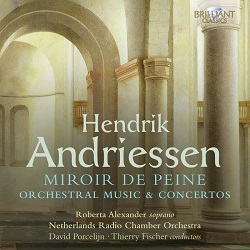
Hendrik Andriessen: Orchestral Music Miroir de Peine; Magna res est amor; Fiat Domine; Variations and Fugue on a theme by Kuhnau; Variations on a theme by Couperin; Chromatic Variations; Concertino for Cello and Orchestra; Concertino for Oboe with String Orchestra; Canzona for Cello Solo and Company; Violin Concerto Michael Müller (cello), Henk Swinnen (oboe), Tinta Schmidt von; Altenstadt (violin) Netherlands Radio Chamber Orchestra/David Porcelijn, Thierry Fischer Recorded June and August 1991, Geertekerk, Utrecht (Orchestral works); November 1997 and May 1998, MCO I, Hilversum (Concertinos, Canzona, Concerto) BRILLIANT CLASSICS 96105 [120:12] Hendrik Andriessen remains one of those composers whose reputation hasn’t quite traveled beyond national borders—a pity, really, given the substance and seriousness of this music. Brother to the more radical Louis, Hendrik carved out a path that honored Dutch Catholic tradition while absorbing the chromatic language of his time without ever capitulating to fashion. This generous Brilliant Classics reissue (originally Naxos material) offers a wide-ranging survey spanning half a century of creative; output, and the picture that emerges is of a craftsman who knew exactly what he wanted to say.
Miroir de Peine, composed in 1923 but not orchestrated until a decade later, announces Andriessen’s aesthetic from the opening bars. The harmonic language owes something to Reger—those dense chromatic progressions, the contrapuntal thicket—but there’s a certain Dutch sobriety that keeps the emotionalism in check. David Porcelijn and — well — the Netherlands Radio Chamber Orchestra navigate these shifting tonal centers with admirable clarity, though I wish the Geertekerk acoustic weren’t quite so reverberant.
Details blur at climactic moments. The two brief sacred pieces, “Magna res est amor” and “Fiat Domine,” reveal Andriessen’s liturgical roots…. These are essentially motets without text, devotional in character but never cloying.
The orchestration is spare, almost ascetic—strings predominate, with winds adding color rather than asserting independence. But it’s the variation sets that show Andriessen’s compositional mettle. The Variations and Fugue on a theme by Kuhnau reveals his baroque affinities while remaining unmistakably twentieth-century in execution.
Each variation explores a distinct affekt, and Porcelijn differentiates them beautifully—the third variation’s string writing has a Hindemithian angularity, while the fifth blooms into unexpected lyricism. The fugue itself is rigorous without being academic, its subject subjected to all manner of contrapuntal manipulation that never feels dry. The Variations on a theme by Couperin, written during the war years, inhabits darker territory.
Andriessen takes Couperin’s elegant theme and subjects it to increasingly chromatic transformation—there are moments here that approach the kind of harmonic density you find in middle-period Schoenberg, though always with tonal anchors somewhere in the texture. The Netherlands Radio Chamber Orchestra plays with real commitment, though ensemble precision occasionally frays in the more complex passages. Most impressive, perhaps, are the Chromatic Variations from 1970.
By this point Andriessen had fully absorbed serial techniques without ever writing a twelve-tone work, and the result is music of considerable expressive power. The theme itself is a chromatic descent that sounds almost like a passacaglia, and the variations build to a climax of genuine intensity. Porcelijn paces this expertly—he understands that this music needs time to breathe, that the harmonic progressions must register fully.
The concertante works occupy the second half of the program, recorded six years later in Hilversum with Thierry Fischer conducting. The acoustic is drier, more analytical, and frankly better suited to this repertoire. Michael Müller proves an eloquent advocate in both the Concertino for Cello and the Canzona—his tone is warm without being overripe, and his skill is secure even in the more treacherous passages.
The Concertino is a rather conventional three-movement affair, but the Canzona has real character, its long-breathed melodic lines unfolding with a kind of meditative intensity. Henk Swinnen’s oboe playing in the Concertino for Oboe is admirable if occasionally a touch strident in the upper register. The work itself is charming without being particularly memorable—Andriessen was clearly more comfortable writing for strings than for winds, and — well — it shows.
The Violin Concerto, the latest work here, receives a committed execution from Tinta Schmidt von Altenstadt, though I confess the piece itself strikes me as the least successful on the disc. At over twenty minutes, it outstays its welcome—the thematic material isn’t quite strong enough to sustain the — structure, and there are longueurs in the slow movement that even Fischer’s alert conducting can’t entirely disguise. Schmidt von Altenstadt plays with conviction, her tone bright and focused, but the solo writing lacks the kind of idiomatic flair that makes a concerto memorable.
Still, this is valuable documentation of a substantial if undervalued composer. The performances range from good to outstanding, the recorded sound is acceptable if not distinguished, and the price is right. Andriessen’s music deserves wider hearing—it’s substantial, well-crafted, and rooted in a tradition that honors the past without merely imitating it.
Not every work here is equally successful — but the best pieces—those variation sets, the Miroir de Peine, the Canzona—reveal a composer of genuine accomplishment. Worth investigating.