
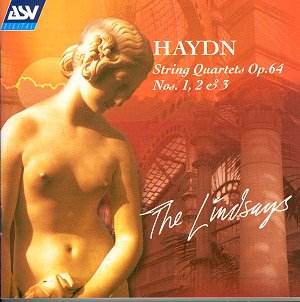
The Lindsays in Haydn: Craft and Conviction
These three quartets from Op. 64—written between 1787 and 1790, when Haydn was at the height of his powers—present particular challenges. Not the obvious technical hurdles, though those exist. Rather, they demand what the Lindsays have always possessed in abundance: a willingness to let the music breathe without imposing interpretive conceits upon it.
The opening "Allegro" moderato of the C major Quartet finds Peter Cropper’s first violin singing with that slightly grainy tone the Lindsays favor—not quite the burnished sheen of, say, the Alban Berg Quartet, but something earthier, more direct. This serves Haydn well. In the development section, where the thematic material fragments and recombines, one hears genuine conversation rather than four instrumentalists merely playing their parts. The viola, Robin Ireland, contributes more than accompaniment here; there’s a moment around 4’20” where his line briefly emerges from the texture with unexpected poignancy.
The B minor Quartet, No. 2 of the set, contains that extraordinary slow movement—marked "Adagio" ma non troppo—which deserves comparison with the great C major Quartet’s "Largo". The Lindsays resist the temptation to linger excessively. Their tempo feels right, neither rushed nor indulgent, though I confess I wanted Bernard Gregor-Smith’s cello to dig in more forcefully at the movement’s climax. The sound recedes slightly there, a question perhaps of balance or release placement in Holy Trinity Church, Wentworth.
One notices throughout this disc how the Lindsays shape phrases with breath-like naturalness. In the B-flat Quartet’s "finale"—that Vivace assai with its folk-inflected materials—they avoid the metronomic evenness that can afflict period-instrument groups attempting this repertoire. There’s rubato, yes, but applied with discretion. The second violin, Roland Birks, deserves special mention for his alertness to inner-voice counterpoint, particularly in the "Menuetto" movements where Haydn often conceals his most sophisticated writing.
The recording itself presents a warm acoustic, though at times—particularly in the more densely scored passages—individual strands blur together. I found myself wishing for greater transparency in the first movement development of Op. 64, No. 3, where Haydn’s part-writing grows especially intricate. This isn’t a fatal flaw, but it matters.
H.C. Robbins Landon called these quartets “perhaps Haydn’s single greatest achievement” of this period, and one understands why. They lack the overt drama of the Op. 76 set, the experimental boldness of Op. 20, yet they possess a Classical perfection—that balance of intellect and feeling—which represents Haydn at his most characteristic. The Lindsays understand this implicitly. Their approach eschews superficial brilliance in favor of long-term architectural coherence.
Not everything convinces equally. The minuet of the C major Quartet wants more contrast between its courtly gestures and rustic trios—the Lindsays play it rather uniformly. And occasionally their vibrato seems too generous for music that benefits from leaner textures. But these are quibbles.
What matters is the seriousness of purpose here, the sense that these performers have lived with this music long enough to move past mere note-perfect execution into something approaching genuine understanding. The Lindsays’ Haydn cycle, of which this forms part, stands as a major achievement—not perhaps the final word on these works, but a word spoken with authority and considerable eloquence.
