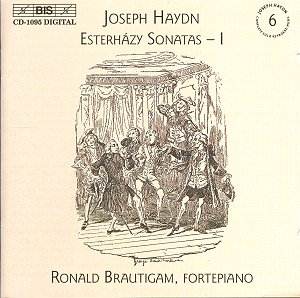
Franz Joseph Haydn (1732–1809)
Esterházy Sonatas, Volume 1 (Complete Solo Keyboard Music Volume 6)
Keyboard Sonatas: No. 35 in A flat, Hob. XVI/43; No.
36 in C, Hob. XVI/21; No. 37 in E, Hob.
XVI/22; No. 38 in F, Hob. XVI/23
Ronald Brautigam, fortepiano (McNulty copy of a late 18th-century Walter)
Recorded August 1999, Länna Church, Sweden [DDD]
BIS CD1095 (70:28)
Ronald Brautigam’s ongoing journey through Haydn’s solo keyboard oeuvre continues to yield treasures.
This latest installment, featuring the so-called Esterházy Sonatas Nos. 35 through 38, is no exception—except that “exception” here translates as a quietly persuasive, if slightly idiosyncratic, argument for deeper engagement with these pieces. The disc opens with No.
35 in A flat, a sonata whose authorship remains a thorny question among Haydn scholars. It notably lacks a slow movement, which, given Haydn’s penchant for expressive breadth, makes it something of an outlier. Brautigam navigates this unusual structure—"Allegro", a brief "Menuetto" and Trio, then a "Rondo" "finale"—with a deft but unassuming touch.
The "Menuetto"’s registral shifts, for instance, receive delicate shading that teases out their subtle contrasts without overstatement. Here, the fortepiano’s light, bell-like timbre—courtesy of the McNulty Walter copy—is captured with crystalline clarity by BIS’s engineers, lending the music an intimate yet spacious aura. No.
36 in C and No. 37 in E, the heart of the Esterházy group, benefit hugely from Brautigam’s measured expressivity. The "Allegro" moderato of No.
36 — with its predominantly two-part texture, could easily fall flat in lesser hands, but Brautigam’s articulation—precise but never mechanical—keeps the weaving lines taut and — well — forward-moving. There’s a conversational quality to his phrasing, as if Haydn’s musical wit and warmth are unfolding in real time. In Sonata No.
37, the opening movement’s orchestral sweep is remarkable, his touch light yet commanding. Small tempo fluctuations—subtle rubati barely perceptible, but crucial—imbue the music with vitality, steering clear of any staleness or rigidity. The "Andante" that follows is a model of restraint; Brautigam’s sensitivity here is palpable, the nuances of voicing and harmonic shading opening out like a carefully unfurled flower.
The "finale", a Tempo di Menuet rather than a typical high-spirited romp, exemplifies Haydn’s ability to end with civility and charm rather than fireworks. Brautigam captures this essence admirably—it feels less a final bow and more a graceful curtsy. No.
38 in F, which overlaps repertoire-wise with Joanna Leach’s recent Athene release, offers a telling comparison. Leach’s use of a Stodart square piano of 1823 is compelling for piano historians, but Brautigam’s musicianship transcends mere instrument choice. His "Adagio", especially, unfolds with a flowing spontaneity and — well — emotional depth that Leach’s more measured approach cannot match.
You sense Brautigam’s intimate familiarity with Haydn’s expressive idiom—the subtle shifts in harmony and texture, the playful inflections—are not just studied but lived. The "Presto" "finale" bursts forth with genuine joie de vivre, a dazzling display of rhythmic precision and buoyant articulation. It’s Haydn’s exuberance distilled, and Brautigam’s performance somehow conjures both the freshness of first hearing and the seasoned reflection of a master interpreter.
Brautigam’s scholarly underpinning—his use of the Wiener Urtext edition—grounds the realization in textual authenticity. Yet what sets him apart is the absence of mere academic coldness; instead, there’s a warmth and wit that illuminates Haydn’s multifaceted expressive world. His fortepiano’s timbral palette is exploited with judicious colouristic shifts, the registral contrasts lending each sonata its unique character without sounding forced or artificial.
The recording venue—Länna Church—adds a silvery resonance that neither muddies nor sterilizes, offering an aural space perfectly suited to these tender, often intimate works. One might quibble that Brautigam occasionally errs on the side of subtlety where a bolder, more extroverted approach would also have merit—Haydn’s humor sometimes cries out for more bite or a touch of cheekiness. Still, these are minor points in a disc that brilliantly balances rigour and spontaneity, intellect and feeling.
To sum up: this volume is a compelling chapter in Brautigam’s Haydn narrative. His thoughtful artistry—and a fortepiano tone that’s as polished as it is playful—makes these — Esterházy Sonatas come alive not as museum pieces but as vibrant music for today’s ear. For those seeking insight into Haydn’s keyboard world beyond the well-worn favorites, this BIS production is indispensable.
And, just as importantly, it’s a reminder that in Haydn, restraint often conceals profound expressive power. I look forward already to what Brautigam will uncover next.