George Frideric Handel (1685–1759)
Great Handel Arias
Bernadette Greevy (contralto, first eight tracks)
Forbes Robinson (bass, last eight tracks)
Academy of St Martin-in-the-Fields
Raymond Leppard (harpsichord and director, Greevy’s selections)
Philip Ledger (director, Robinson’s selections)
Recorded 1966–67
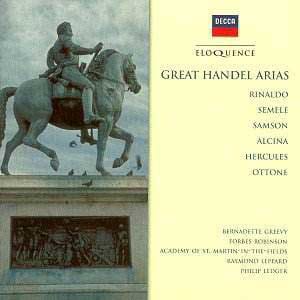
DECCA ELOQUENCE 461 593-2 [77’34]
This reissue, a sturdy if somewhat antiquated capsule of mid-60s Handel realization practice, offers a fascinating glimpse into two contrasting vocal approaches to Handel’s rich aria repertoire. Bernadette Greevy’s contralto, framed by Raymond Leppard’s deft harpsichord continuo and the Academy’s strings, is the more immediately compelling — half of this disc, while Forbes Robinson’s bass, under Philip Ledger’s baton, presents a more blunt, occasionally uneven counterpoint. Greevy’s voice — dark, resonant, and imbued with a certain plangent melancholy — manifests a rare sensitivity from the outset.
Take “Vieni, o figlio” from Ottone: her lower register is notably sumptuous, the tone shaped with a kind of noble restraint that avoids any hint of heaviness. The players supports her with a transparent delicacy, a shimmering undercurrent in the strings that allows the vocal line to breathe with natural ease. Leppard’s harpsichord is judiciously placed, never intrusive, gently weaving through the texture with a; sprightly elegance that, at times, reminds you why his name is synonymous with baroque revival.
In “Convey me to some peaceful shore” from Alexander Balus — a relatively obscure gem — Greevy’s text declamation is strikingly clear and affecting, her phrasing punctuated by subtle dynamic shading and a commendable command of Handelian ornamentation. Her runs in “Cangio d’aspetto” (from Admeto) are particularly well measured, each note cleanly — articulated, showing breath control that allows for a languorous expansion of phrase without strain. The cello obbligato in “Dove sei” (Rodelinda) is brought forward with an almost tactile warmth, the interplay between voice and strings creating an intimacy that modern performances sometimes lack.
Here, Leppard’s sensitivity to the continuo bass line adds a lustrous depth, underscoring Greevy’s discreet portamentos and tasteful rubato choices. Yet, not all is seamless. “La Rondinella,” a cantata movement, might strike some as overly florid, even a touch mannered — the harpsichord’s spirited figuration at times threatens to overshadow the vocal line.
But for those willing to indulge in its baroque exuberance, it offers a refreshing vitality rarely captured on disc. Turning to the bass repertoire, Forbes Robinson’s voice is a different story — one of solid, if slightly antiquated gravitas. His “Revenge, Timotheus cries” (Alexander’s Feast) is robust, though occasionally marred by a certain blustery tone and a lack of tonal focus that betrays his advancing years.
The runs are competent but lack the fluidity one might hope for, and the orchestral support, while sturdy, doesn’t always mesh organically. Yet — moments of vivid characterization emerge; in the harsh sibilants of “hiss,” his delivery is notably menacing without tipping into caricature. It’s a small but telling detail that reminds us of the dramatic potential inherent in this music.
The warm acoustics of the concert hall seem to breathe through the release.
In “Se un bell’ardier” (Ezio), Robinson’s lower register fills the acoustic space with cavernous depth, albeit with breath control that borders on labored in longer phrases. “The God of Battle” (Hercules) reveals a tendency towards ungainly runs, which somewhat undercut the otherwise stirring martial rhetoric. Conversely, “Leave me, loathsome Light” from Semele is elegantly introspective — here, Robinson’s tone softens with a reflective timbre, beautifully complemented by Ledger’s sensitive orchestral textures, giving the aria a philosophical weight that resonates deeply.
Technically, the transfers are commendable: the original analog warmth preserved without undue compression. Unfortunately, the booklet offers no texts, only précis, which undoubtedly frustrates those who prize full libretto engagement for Handel’s often intricate and poignant recitative-aria structures. In sum: this collection stands as a testament to the interpretive climate of the 1960s — a period straddling historically informed impulses and — well — lingering Romantic sensibilities.
Greevy and Leppard’s collaboration remains the disc’s shining jewel, illuminating Handel’s vocal line with affectionate clarity and refined musicianship. Robinson and Ledger, while less consistently persuasive, contribute moments of weight and character, rounding out a programme that,; despite its age, retains considerable interest for Handel devotees curious about vocal styles predating the modern early-music explosion. Is this the definitive Handel arias disc?
No. But it is a valuable historical document, rich in texture and interpretation, well worth revisiting for those seeking a mid-century perspective on Handel’s enduring vocal treasures.