
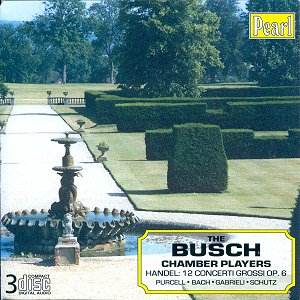
Adolf Busch’s Handel: Historical Splendor, Occasional Stodginess
There’s something both exhilarating and frustrating about these Pearl reissues—the thrill of archaeological recovery bumping up against the reality that not everything unearthed deserves unqualified veneration. Adolf Busch’s 1946 Handel Concerti Grossi, Op. 6, recorded in New York and long thought nearly extinct, arrives with the kind of provenance that makes collectors salivate: acetates borrowed from the violinist’s widow, painstaking transfers, the whole archival apparatus. But provenance isn’t rendition.
And the performance? Well, it’s complicated.
Busch brings to Handel a Germanic seriousness—not necessarily a liability—that occasionally hardens into something perilously close to solemnity. These are noble readings, certainly, with firmly focused string tone and judicious portamenti that never descend into schmaltz. The phrasing tends toward the crisp, which suits the architectural clarity of Handel’s writing. But there are moments, particularly in the slower movements, where tempi don’t just broaden—they congeal. The Larghetto of the First Concerto feels less contemplative than becalmed.
Boyd Neel’s piecemeal 1936–38 traversal (which Jonathan Woolf’s notes rightly invoke) suffered similar lapses, though Neel had Arnold Goldsborough at the harpsichord, whose subtle continuo work provided rhythmic ballast and textural fillip. Busch employed Mieczysław Horszowski—a pianist of considerable refinement—who remains, alas, almost entirely inaudible. This isn’t entirely the fault of the 1946 engineering, which is remarkably faithful for its vintage. One suspects the microphone placement simply didn’t favor the keyboard. The result: a certain textural thinness in passages where Handel’s harmonic scaffolding cries out for chordal punctuation.
Where Busch excels is in the dance movements—the "Allegro"s and Hornpipes acquire genuine spring and vitality. His Chamber Players respond with disciplined élan, and there’s a transparency to the part-writing that anticipates historically informed practice without abandoning vibrato or adopting the leaner sonorities that would come later. These are transitional documents, caught between Romantic amplitude and Baroque athleticism, and that very betweenness gives them documentary fascination.
The live 1943 Town Hall concert material that fills out this three-disc set offers Bach’s First Orchestral Suite—weightier and more deliberate than their celebrated 1936 commercial release. It’s an interesting comparison study, though whether the increased gravitas represents deepening interpretive wisdom or simply an off night is impossible to say. Christine Johnson’s soprano navigates Schütz’s Die teutsche gemeine Litaney with clear tone and good German diction, accompanied by the young Lukas Foss at the piano. It’s a curiosity, really—piano continuo in Schütz feels anachronistic even by 1943 standards—but Johnson’s directness serves the austere devotional text. The Gabrieli Canzon a dieci receives robust, somewhat bluff treatment.
Pearl’s transfer work deserves commendation. Given the source materials—acetates and borrowed discs—the sonic fidelity impresses, with minimal surface noise and reasonable dynamic range. The annotation is thorough without being pedantic.
But here’s the rub: historical importance doesn’t automatically confer artistic indispensability. These Handel concertos occupy an honorable place in the discography’s evolution, documenting Busch’s thoughtful if occasionally earthbound approach. They’re not, however, first-choice recommendations for listeners wanting to actually hear Op. 6 at its most persuasive. The slow movements sag. The harpsichord barely registers. And while Busch’s expressive restraint represents a legitimate aesthetic choice, restraint can shade into reticence.
For scholars, collectors, and Busch devotees—yes, absolutely. For everyone else? Approach with measured expectations. The archaeology is impeccable. The music-making is merely honorable.
