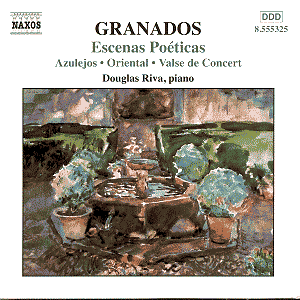
Enrique Granados: Piano Music, Volume 5 Douglas Riva (piano) Recorded June 2000, Potton Hall, Dunwich, Suffolk Naxos 8.555325 [62:28] Granados’s; piano oeuvre, a tapestry as intricate as it is tender, has long invited champions willing to excavate its less trodden corners. This fifth volume on Naxos, with Douglas Riva at the keyboard, promises such an expedition, boasting three world premiere recordings alongside established fare. Yet the question lingers: does it illuminate Granados’s creative architecture anew, or are we simply brushing a little more dust off familiar panels?
The disc opens with the curious Azulejos, a hybrid work begun by Isaac Albéniz and completed posthumously by Granados. Here we have a fragmentary collaboration: Albéniz’s 63 bars segue into Granados’s 83, a kind of compositional palimpsest. Unfortunately, the piece feels less like a living dialogue and more like shavings from the workbench—interesting for the scholar, less so for the listener craving fully integrated musical narrative.
The warm acoustics of the concert hall seem to breathe through the production.
The transitions are somewhat awkward, revealing the patchwork rather than the seamless. Riva’s execution sparkles most vividly in the Valse de Concert, probably penned around 1909–10, published mere years before Granados’s tragic death. There’s undeniable brio in Riva’s attack; his fingers dance with a certain joie de vivre that suits the piece’s salon character.
Yet, the rubato occasionally tips into being overly calculated, drawing attention to itself and impeding the natural ebb and flow of waltz rhythm. One longs for a freer, more spontaneous pulse, something less like measured breath and more like a dance floor’s unpredictable sway. The Escenas Poéticas present a range of moods and technical textures, composed over several years.
Here, Granados’s voice becomes more complex and prismatically compelling. Take “El ángel de los claustros” — an intriguing depiction of an angel’s interrupted flight — overlaid with a solemn chorale. Riva’s tempo choices for this are a bit too ponderous; the music cries out for subtle; liminality, a hint of the ethereal hovering between groundedness and flight, which remains just out of reach.
Intriguingly, Riva’s liner notes point to the fourth piece in the cycle as Schumann-influenced. I would counter that it is the "finale", “El sueño del poeta,” that wears Schumann’s imprint with the most clarity. There’s that characteristic blend of lyricism and brooding introspection, the kind of nocturnal fantasy that feels simultaneously intimate and vast.
Riva approaches this with respect, though occasionally the phrasing feels over-labored, as if trying — too hard to carve out profundity where a gentler touch might reveal it more naturally. The disc closes with three premieres styled “Oriental” — a nod to Granados’s fascination with Arabic-influenced idioms from Spain’s own historical interlace with the Moors. These pieces, merging light entertainment with mild pedagogical ambitions, occupy a more gauzy, less robust territory.
They’re charming enough but hardly vital, and their occasional melodic clichés make them slight curiosities rather than indispensable repertoire. A note on sound: the recording quality here is serviceable but somewhat airless—there’s a dryness that strips the piano’s resonance of some warmth and — well — colour, particularly noticeable in the sustained chords and rubato passages where the instrument’s breath should be felt as much as heard. Riva’s affinity with Granados is evident, and his dedication to bringing lesser-known works into the light commendable.
Yet at times his interpretive choices tip toward the didactic rather than the inspired, leaving the music’s inherent poetry a little undernourished. That said, the liner notes are erudite and helpful, providing context often absent in the exploration of Granados’s more peripheral works. In sum, this volume is a qualified welcome.
It extends the Granados discography with worthwhile, if not revelatory, additions. For the completist or those intrigued by Granados’s later, less canonical output, it offers moments of genuine interest and a few flashes of beauty. But it stops short of transforming our understanding of the composer’s pianistic language or emotional universe.
A valuable, if cautious, step forward.