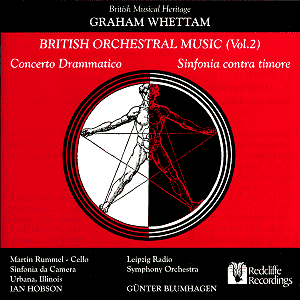
Graham Whettam: Concerto Drammatico; Sinfonia contra timore**
Martin Rummel, cello; Sinfonia da Camera, Urbana, Illinois/Ian Hobson; Leipzig Radio Symphony Orchestra/Günter Blumhagen
UNIVERSAL RR 017 [60:00]
Graham Whettam—born 1927, which makes him a near-contemporary of Tippett’s later manner though sharing almost nothing of that composer’s aesthetic—has been one of British music’s more stubborn individualists. Stubborn in the best sense. He writes what he needs to write, when fashion dictates otherwise, and — well — the music on this disc proves the rightness of his course.
The Concerto Drammatico has a curious genesis. Originally a two-movement Cello Concerto from 1962, it waited until 1981 for its premiere—Robert Cohen with the BBC Northern under Timothy Reynish. Nearly four decades later, Whettam revisited those “scenas” (his term), sandwiched a new "Scherzo" between them, and created something rather different.
The maestro’s presence feels palpable even in this studio setting.
The architecture now reads: Scena, "Scherzo", Ultima Scena. Three movements, but really a triptych where the central panel throws the outer meditations into sharper relief. I confess some skepticism about such retrofitting.
But here it works—more than works. The original conception was predominantly elegiac, inward-turning, with those carefully placed climaxes that Whettam manages so well. The "Scherzo" doesn’t betray that character; it intensifies the drama through contrast.
Martin Rummel plays with fierce commitment in this September 2000 recording from Illinois. His tone in the opening Scena has that burnished darkness the music needs, and when Whettam asks him to dig in—and he does ask, repeatedly—Rummel delivers without coarseness. The passagework in the "Scherzo" could sound merely athletic; instead, it sounds necessary, even desperate.
Ian Hobson and the Sinfonia da Camera provide lean, responsive support, though one wishes for slightly more weight in the ensemble’s climactic moments. Still, this is a powerfully gripping piece—one of Whettam’s finest achievements, I’d argue—and the performance does it justice. The coupling is revelatory.
Sinfonia contra timore dates from 1962, the same year as the original cello work, and shares something of its emotional temperature. Whettam dedicated it to Bertrand Russell “and all other people who suffer imprisonment or other injustice — for the expression of their beliefs”—Russell was briefly jailed during the Cuba crisis for inciting civil disobedience. But this isn’t program music in any literal sense.
It’s a response to the times, yes, but expressed in purely symphonic terms. The work opens with a menacing prelude—low brass, shifting harmonies that never quite settle—before launching into an "Allegro" molto of considerable nervous energy. Whettam loves unison horns and trumpets to announce his big themes — and here they do exactly that, cutting through the texture with almost physical force.
What follows is a violently energetic dance (his word “dance” seems almost ironic given the music’s driven character) that maintains its momentum through sheer compositional will. A massive glissando—startling when it arrives—ushers in the "finale", which frames a central "Scherzo" within two slow sections. The architecture mirrors the concerto’s, though this predates it by decades.
The 1975 interpretation by the Leipzig Radio Symphony under Günter Blumhagen is simply superb. Better than superb—it’s definitive. The Germans play this music as if it were Hartmann or late Hindemith, with absolute seriousness and technical security.
The brass section deserves special mention; they have the heft and precision Whettam’s writing demands. That opening "Allegro" molto drives forward with incisive energy, and the final pages—defiant, uncompromising—land with genuine impact. Whettam’s harmonic language isn’t easy to categorize.
It’s tonal but chromatic, dramatic but never merely rhetorical. He knows how to build to a climax and, crucially, when to pull back. The slow music in both works has genuine expressive weight—not just slow for contrast’s sake, but slow because the material needs time to breathe, to develop, to speak.
Both works deserve to be far better known than they are. Whettam has been shamefully neglected, perhaps because he fits no convenient category, follows no approved path. This disc—part of Redcliffe’s British Orchestral Music series—makes a compelling case for reassessment.
The recorded sound is distinguished throughout: clear, well-balanced, with ample space around the instruments. At midprice, it’s an essential purchase for anyone interested in postwar British music beyond the usual suspects. I hope we might soon have a production of Sinfonia Drammatica, completed in 1978 and premiered by Blumhagen.
Based on this evidence, it ought to be extraordinary.