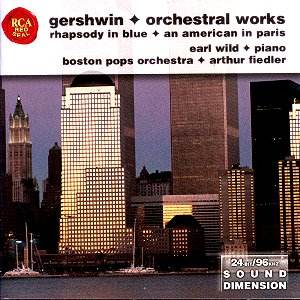
Gershwin: Orchestral Works
Earl Wild (piano); Boston Pops Orchestra/Arthur Fiedler
RCA Red Seal 74321 68019 2 [70:02]
There’s something to be said for recordings that know exactly what they are. This Gershwin anthology from the late fifties and early sixties—Rhapsody in Blue, the Concerto in F, An American in Paris, and the “I Got Rhythm” Variations—makes no claims to profundity or revisionism. What it offers instead is solid, professional music-making from artists who understood the idiom intimately, even if they didn’t always penetrate to its heart.
Earl Wild’s credentials were impeccable: he had toured America’s heartland with the Paul Whiteman Band, playing the Rhapsody in something approaching its original context. That pedigree ought to count for something. Yet listening to this recording, I found myself wondering whether too much had been learned, too much refined. The opening clarinet glissando gets its answer from Wild with a certain… deliberation. Those famous tempo fluctuations, the ritardandos and sudden accelerations that give the piece its jazz-inflected swagger—they’re all here, but they feel considered rather than spontaneous. There’s middle-aged spread, if you will.
I went back to Gershwin’s own 1927 recording with Whiteman. The difference isn’t in the notes—Wild’s pianism is vastly superior, technically speaking—but in the quality of risk. Gershwin sounds like he’s improvising the piece on the spot (which, in a sense, he was still doing in those early years). Wild sounds like he’s interpreting it. That’s not necessarily fatal. On a second hearing, without the score in front of me, the rhythmic exaggerations bothered me less. The playing has real brilliance, and Fiedler—who knew this repertoire as well as anyone—captures something of Whiteman’s brash energy, even with a full symphony orchestra at his disposal. They simply can’t match Bernstein’s extraordinary 1959 Columbia recording, which somehow manages to sound both wild and inevitable, as though the music were being recomposed in real time without changing a note. But that’s an unfair standard.
The Concerto in F fares better. Wild navigates the first movement’s thorniest passages with admirable clarity, though the piano sound itself—rather boxy and two-dimensional in this elderly recording—robs his tone of color. The slow movement needs more inwardness than either Wild or Fiedler provides; it’s well-played but doesn’t quite sing. The "finale", though, has genuine verve. Wild digs into those syncopations with conviction, and Fiedler whips up considerable excitement. Compare this to the fragmentary recording Gershwin himself made of the "finale", and Wild doesn’t suffer by the comparison.
An American in Paris gets a lithe, propulsive reading. Fiedler keeps the famous blues theme moving—no wallowing here—and the final Charleston section has plenty of brilliance and snap. I heard Seiji Ozawa’s Boston Symphony recording recently, and it was so lovingly molded, so carefully balanced, that it ended up sounding like Elgar’s Cockaigne with taxi horns. Fiedler never makes that mistake. This is unabashedly American music, and he treats it accordingly.
The “I Got Rhythm” Variations show Wild at his most assured. These are virtuoso pieces, after all, and he dispatches them with the kind of pianistic authority that made him famous. If there’s not much beneath the surface… well, perhaps there isn’t meant to be much beneath the surface. Gershwin was writing show-off music, and Wild shows off admirably.
What keeps this from being a great Gershwin release—as opposed to merely a good one—is a certain lack of personality. Wild plays everything correctly, even brilliantly, but without revealing much of himself in the process. The piano sound doesn’t help: it’s rather flat and monochromatic, and the famous Boston Symphony Hall reverberation, which can be such an asset, here tends to blur orchestral detail. Inner voices disappear, and the string sound becomes generalized.
Still, as a basic Gershwin package for someone just getting acquainted with these works, this will serve perfectly well. Everything is here, everything is competently done, and at super-budget price there’s little to complain about. Just don’t expect the electricity of Bernstein or the sheer pianistic glamour that, say, André Previn brought to this repertoire. Wild and Fiedler give us workmanlike Gershwin—which, given the composer’s own pragmatic approach to music-making, might not be entirely inappropriate.
One final note: the booklet claims that Fiedler succeeded “the distinguished Italian composer Alfredo Casella” as director of the Boston Pops in 1930. This cannot possibly be correct. Casella, Italy’s leading modernist and a follower of Stravinsky, was fully occupied in Europe during those years, writing his most acerbic and uncompromising music. The idea of him leading the Boston Pops is about as plausible as Schoenberg conducting light opera in Vienna. A namesake, surely—or simply an error. Someone at RCA should check their facts.
Christopher Howell