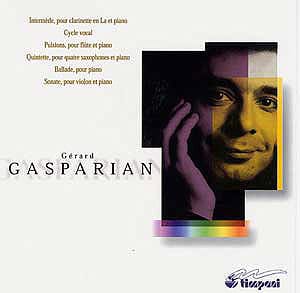
Gérard Gasparian: Chamber Works and Songs Sylvie Hue (clarinet), Marie Kobayashi (mezzo-soprano), Emmanuelle Ophèle (flute), Hidéki Nagano (piano), Yoko Yamasaki (piano), Jean Ter-Merguérian (violin), Quatuor de Saxophones Jean Ledieu Recorded Paris,; 1998/99 Label: Timpani 1C1055 [59:56] — Gérard Gasparian’s disc, a rare and revealing glimpse into the oeuvre of this French pianist-composer born in 1960, is at once intriguing and—let’s admit it—uneven. But unevenness, here, is part of the charm and challenge. We’re dealing not with a facile modernist or a postmodern pastiche artist, but with a man wrestling—sometimes awkwardly, sometimes; with brilliant flashes—with a set of inherited vocabularies: Poulenc’s motoric verve, Ligeti’s mechanical canon, and the lieder tradition’s emotional austerity.
You can almost hear the rosin dust settling on the strings.
The Intermède for clarinet in A and piano opens the program with a brash, restless energy that almost feels fractured—jagged melodic shards alternate with transiently lyrical episodes. Sylvie Hue’s clarinet is incisive, biting into the phrases with sharp articulation, the A clarinet’s natural warmth occasionally brought to bear, yet never losing that underlying tension. The piano’s motor rhythms recall Poulenc superficially, but Gasparian eschews Poulenc’s genial wit for something more earnest, less charming.
It’s music that demands rather than invites, and the high-velocity passages at times threaten to spill over, but in a way that feels honest rather than sloppy. Then the Cycle Vocale—settings of Mörike’s poetry—shifts dramatically in mood and texture. Marie Kobayashi’s mezzo-soprano is a marvel: her tone is firm, centered, and crucially, unyielding in its purity of pitch.
The vibrato-less conclusion of “Nimmersatte Liebe” is particularly striking, lending a spectral austerity that underlines the insatiable longing the text conveys. The piano accompaniment, helmed by Gasparian himself, is sensitive and precisely shaded, though the album suffers a curious moment of distortion mid-cycle that jars a little—but only a little—from the otherwise immaculate soundscape. Pulsions for flute and — well — piano returns us to that fragmented, restless texture.
Emmanuelle Ophèle’s flute is nimble and — well — fleet, weaving through aleatoric passages that feel like controlled chaos. The central section’s aleatoric elements introduce a breath of unpredictability, as if the instruments engage in a subtle game of call and response where control is deliberately softened. Nagano’s piano playing is both supportive and assertive—never content to merely accompany, but rather to engage in a genuine dialogue.
The centerpiece here is unquestionably the Quintet for four saxophones and piano (1997). Here Gasparian embraces the expanded saxophone family with a resourcefulness that feels both fresh and grounded. He resists relegating the piano to mere accompaniment; it enters only in the second movement, “Canon, fanfares,” where Ligeti’s shadow looms—those mechanical, almost clockwork canonic lines are executed with rigorous precision by the Jean Ledieu Saxophone Quartet.
The texture throughout is lush in places, stark in others, with sharp contrasts—moments of brittle, almost metallic biting giving way to passages of warm, full-bodied resonance. The "finale", marked Prestissimo, bristles with energy, and — well — the quartet’s heavy breathing at the very end—an odd, almost theatrical detail—adds a raw human touch to the otherwise tightly controlled sonic landscape. Rounding out the disc are the Ballade for piano and — well — the Violin Sonata.
Yoko Yamasaki’s piano playing in the Ballade is idiomatic, atmospheric, a bit like a fleeting reverie caught in amber; Gasparian’s touch is clear, weighty where necessary, yet fluid. Jean Ter-Merguérian’s violin in the sonata is expressive, handling the shifting moods—from the gentle Andantino through the waltz-like Valse to the spirited Scherzo and "finale"—with palpable commitment. The Sonata’s structural ambitions are evident, though moments of harmonic predictability betray the composer’s still developing voice.
Gasparian’s music is, above all, earnest: it wears its seriousness openly and sometimes to a fault. Charm and wit are in short supply, but what’s here is thoughtful, challenging, and often compelling. He is clearly a man still emerging, not fully settled, but with a distinctive voice taking shape amid a dense thicket of influences.
The performances are uniformly exemplary, the recording clear and well-balanced save for that odd hiccup in the vocal cycle. For those curious about the intersection of French chamber music tradition with late-20th-century modernist impulses, this disc offers a worthwhile—if imperfect—entrée. Gasparian’s compositional language is still coalescing; the promise is there, even if the masterpiece remains some years ahead.
A disc to engage with seriously, and to watch for future developments from this thoughtful, if occasionally austere, artist.