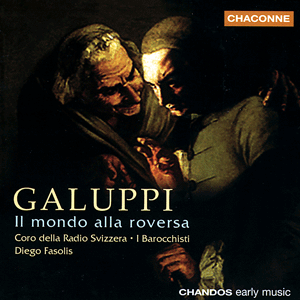
Baldassare Galuppi
Il Mondo alla Roversa (The World turned Topsy-Turvey), a burlesque drama in music (1750)
Marinella Pennicchi (sop, Tulia), Rosa Dominguez (mezzo, Aurora), Mya Fracassini (mezzo, Cintia), Lia Serafini (sop, Rinaldino), Furio Zaasi (bar, Graziosini), Fulvio Bettini (bar, Giacinto), Davide Livermore (ten, Ferromonte)
Swiss Radio Choir, I Barocchisti, Diego Fasolis (director)
Production: Stelio Molo Auditorium, Lugano, Switzerland, November 1998
Label: CHANDOS CHAN 0676 (2 CDs; 73:07 + 77:48)
It’s quite the treat—this revival, peeling back the velvet dust on Galuppi’s Il Mondo alla Roversa, an 18th-century operatic burlesque that tilts the gender order on its head with a comic yet sharp edge. The CHANDOS recording, captured in the warm acoustic of Lugano’s Stelio Molo Auditorium, brings to life a work that rarely graces the stage or disc, let alone with such finesse. Galuppi, well known to musicologists for his pivotal role in shaping opera buffa alongside Goldoni’s text, is often underrated outside specialist circles.
Yet here, his orchestral writing—less flamboyant than contemporaries but subtly and deftly crafted—reveals a composer who understood the power of rhythm and harmonic colour to underpin theatrical momentum. Notably, his use of the concerted "finale" anticipates Mozart’s ensemble "finale"s with a proto-classical clarity. The ensemble under Diego Fasolis responds with supple articulation and a lightness of texture, never allowing the continuo or strings to overpower the singers—this is Baroque transparency at its best.
The plot itself—a topsy-turvy island governed by women wary of their physically stronger male consorts—is ripe for comedic exaggeration, and the cast embraces this with evident relish. Marinella Pennicchi’s Tulia is a beacon of vocal purity. Her soprano, slender but secure, floats over the orchestra with a crystalline ease — and her trills, especially in Act 1’s arias, shimmer with innocent yet ironic command.
By contrast, Lia Serafini’s Rinaldino occasionally unsettles with a rougher timbre and uneven middle register—less an aesthetic choice, more an audible strain that jars in moments of lyrical repose. One wishes her voice had the silkier texture her role demands; still, her comic timing and dramatic instincts remain intact. The two mezzos, Rosa Dominguez and Mya Fracassini, expertly delineate Aurora and Cintia with distinct — vocal colours—the former lighter and more coquettish, the latter leaning toward the contralto’s earthier depth.
Their duets sparkle with crisp intonation and the interplay between their voices cleverly mirrors the machinations of their characters. Baritones Fulvio Bettini and Furio Zaasi bring complementary textures to Giacinto and Graziosini, though their similar — timbral palettes occasionally blur character distinction in ensemble passages—a minor confusion in an otherwise clear vocal tapestry. Davide Livermore’s Ferromonte, the reluctant male rebel, stands out.
His tenor carries a Mozartian edge—bright, incisive, and occasionally biting—delivering the pivotal role with both vocal assurance and theatrical gravitas. The Swiss Radio Choir, skillfully integrated by Fasolis, provides a vibrant and polished choral underpinning, enhancing the ensemble "finale"s and lending weight to the social satire. The dynamics are well calibrated, the choral articulations crisp yet warm, avoiding any hint of stiffness that sometimes plagues period ensembles.
The recording itself is a model of clarity and balance. Chandos’s engineering here shines: the soundstage breathes with a natural reverberation, giving the strings — a shimmering presence and allowing the human voice to emerge with intimacy and immediacy. It’s an admirable achievement, especially given how many period opera recordings suffer from overly dry or overly resonant acoustics that obscure details.
If one were to nitpick, the secco recitatives occasionally lack a bit of rhythmic flexibility, — perhaps a touch more rubato would better capture the conversational nuances Galuppi and Goldoni’s collaboration demands. Yet that quibble aside, this set crackles with life and wit. In sum, this Il Mondo alla Roversa is not merely a curiosity but a genuine rediscovery—a window into the evolution of comic opera and the nuanced balance of gender and power portrayed through music and drama in mid-18th century Venice.
The performers and conductor do full justice to Galuppi’s craft, bringing out the humour and humanity beneath the veneer of baroque ornamentation. It’s a recording to savour, listen to repeatedly, and perhaps, most importantly, to perform anew. A worthy addition to any baroque opera aficionado’s collection—and a reminder that the world of operatic comedy before Mozart’s dominance was more than just a prelude; it was a vibrant, inventive sphere all its own.