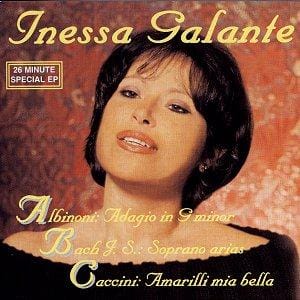
Tomaso ALBINONI (1671-1751)
"Adagio" [8:45]
J.S. BACH (1685-1750)
Ei wie schmekt der Coffee [4:29]
Cantata 144 – Genugsamkeit (arr. D.Golightly) [3:26]
G. CACCINI (1545-1618)
Amarilli mia bella (arr. N.Ingman)
J.S. BACH (1685-1750)
Magnificat – Quia respexit [2:28]
Cantata 21 – Seufzer tranen Kummer (arr. D.Golightly) [3:45]
Inessa GALANTE (soprano)
Orchestra of Latvian National Opera/Aleksandrs Vilumanis
London Musici/Mark Stephenson
Rec Riga Recording Studio, Latvia 1995, St Silas Church, Kentish Town 1999
CAMPION RECORDS RRSP 8001 [26.08]
There’s something almost touching about the guileless ambition of this Campion EP—touching in the way a well-meaning dinner guest might be who brings supermarket tiramisu to an Italian grandmother’s table. Inessa Galante, the Latvian soprano positioned here as the next crossover sensation, has been given baroque repertoire the way one might accessorize an evening gown: purely for decorative effect.
The program notes tell us more about her restaurant engagements than about Bach’s cantatas. Fair warning, that.
Let’s address the Albinoni Adagio first—or rather, the Giazotto pastiche that refuses to die despite scholarly consensus. Someone has decided this warhorse needed a soprano vocalise plastered atop it, and the result sounds like Puccini wandered into the wrong century and couldn’t find his way out. Galante’s tone here is creamy enough, rounded in that generalized lyric-soprano way, but there’s zero sense of baroque affect or rhetoric. It’s singing, certainly. But it’s singing at the music rather than through it.
The Bach fares no better—possibly worse, given that Bach actually wrote these pieces. “Ei wie schmeckt der Coffee” from the Coffee Cantata should sparkle with irony and character, the young woman’s addiction to the fashionable new beverage rendered with theatrical verve. Instead we get vibrato soup, every phrase swimming in the same undifferentiated warmth. The words? Barely intelligible. The wit? Drowned. “Seufzer, Tränen, Kummer, Not” from Cantata 21 wants a certain inwardness, a particular quality of Lutheran contemplation that Galante’s generalized expressivity simply cannot provide.
And then there’s the arrangement question—because of course these pieces have been “arranged.” David Golightly’s name appears as arranger, Nick Ingman’s too, and one suspects their brief was to make everything sound like the soundtrack to a period drama where the director cares more about the costumes than the history. The London Musici and the Orchestra of Latvian National Opera do what they’re asked, which is to provide lush, unobtrusive cushioning. Mark Stephenson and Aleksandrs Vilumanis conduct with the kind of anonymous competence that neither offends nor enlightens.
Galante herself possesses a pleasant instrument—there’s no denying that. The voice sits comfortably in the middle range, rounds out nicely on sustained tones, and produces an agreeable sound that would probably fill a church wedding quite satisfactorily. But pleasant isn’t enough when you’re tackling Bach, even Bach bowdlerized beyond recognition. The occasional forced note in the upper register betrays technical limitations, and the vibrato—Lord, that vibrato—never stops, never varies, never responds to textual or musical demands. It’s the vocal equivalent of a single brushstroke applied to every surface regardless of what the painting requires.
Caccini’s “Amarilli mia bella” receives treatment so far removed from early baroque practice that one wonders why they bothered with repertoire from 1600 at all. Why not just commission some new songs and be done with the pretense? The arrangement is comical if you have any acquaintance with monody, with the radical innovations of the Florentine Camerata, with the very notion of sprezzatura. But then, this isn’t really Caccini. It’s Caccini-flavored product.
I don’t mean to sound cruel. There’s a market for this sort of thing—Classic FM has built an empire on it, and plenty of listeners want beauty without challenge, melody without context, voice without style. Inessa Galante delivers exactly that. She sings tunefully. She never shocks or disturbs. She’d be perfectly fine in a restaurant by the Thames, providing aural wallpaper while diners discuss their portfolios.
But call it what it is: background music for people who don’t actually like classical music, who want its prestige without its demands. At twenty-six minutes, the EP has the decency to be brief. Whether that’s mercy or missed opportunity depends entirely on your tolerance for baroque repertoire stripped of everything that makes it baroque—the rhetoric, the ornamentation, the textual sensitivity, the historical awareness, the stylistic integrity.
The specialist collector will find nothing here. Absolutely nothing. Even the curious listener interested in Galante herself would do better to seek her out in repertoire that actually suits her gifts—Puccini, perhaps, or Dvořák, music where her generalized lyricism and steady vibrato might find more appropriate employment.
This is music for Auntie May, as the original reviewer noted—and bless Auntie May, but she deserves better too.