
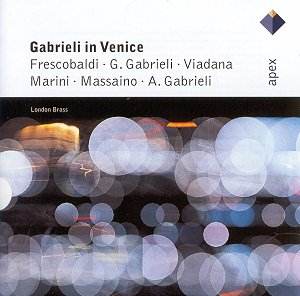
Gabrieli in Venice: London Brass under Philip Pickett
APEX 0927 40823 2 (61:19)
The brass ensemble as we know it today—gleaming modern instruments, pristine intonation, that particular kind of technical swagger—has been feasting on Renaissance polychoral music for decades now. Usually with mixed results. What distinguishes this London Brass album from the general run of such transcriptions is the presence of Philip Pickett, who brings his early-music credentials to bear on repertoire that, let’s be frank, doesn’t really need brass instruments at all. Giovanni Gabrieli and his contemporaries wrote for the instruments they had: sackbuts, cornetti, the whole ceremonial panoply of St. Mark’s. But if we’re going to have modern brass tackle this music—and apparently we are—then better this way than most.
The opening “Canzon Duodecimi Toni a 10” announces the ensemble’s intentions clearly enough. The playing is clean, precise in those racing scalar passages, but notably restrained. No one’s showing off. That’s the Pickett influence, I suspect—a kind of period-practice sobriety applied to instruments that can, in less disciplined hands, turn Venetian splendor into mere bombast. The famous “Sonata Pian e Forte” benefits especially from this approach; its antiphonal exchanges emerge with genuine architectural clarity rather than as an excuse for dynamic pyrotechnics.
I’m less convinced by the Andrea Gabrieli “Aria della Battaglia.” Yes, the battle scene has rhythmic vitality, and Pickett’s edition (he doesn’t tell us much about his editorial principles, alas) keeps things moving. But Andrea never had his nephew’s harmonic imagination—that’s hardly news—and no amount of skilled brass playing can disguise the somewhat square-cut quality of the invention. The piece works well enough as a palate cleanser between the more substantial works, nothing more.
The real discoveries here lie in the byways. Tiburtio Massaino’s “Canzon XXXIII per otto tromboni“—eight trombones!—achieves something genuinely remarkable: a sonority that does approach the organ-like depth the annotator claims. That contra-bass trombone (and what a magnificent beast that instrument is) provides a foundation that transforms the entire texture. This is music that understands the low end not as mere support but as active participant in the harmonic discourse. Massaino, who wandered across Europe in the 1590s leaving traces of his work in various cathedrals, deserves to be better known.
Biagio Marini’s “Sonata in Echo” shows how effective these spatial effects could be—one imagines the antiphonal choirs separated in St. Mark’s vast spaces, sound bouncing off gold mosaic and marble. The organist (uncredited, though presumably Pickett himself) provides discreet continuo support. The echo effects themselves are perhaps a bit too literal, but the piece has genuine charm.
The two Frescobaldi canzonas offer welcome contrast. The “Canzon a 4” particularly reveals that composer’s contrapuntal ingenuity—those unexpected harmonic sideslips, the way he’ll suddenly introduce a chromatic inflection that colors the entire phrase. This is music that rewards close listening, and London Brass has the technical command to make those details register.
By the final “Canzon XVIII a 14,” with its fourteen independent parts weaving through each other, one appreciates what this ensemble has accomplished. Listen around 0:45 to that trombone line—it’s doing something harmonically audacious, pushing against the prevailing tonality in ways that must have startled early seventeenth-century ears. The players navigate these complexities with admirable clarity, never allowing the texture to congeal into undifferentiated brass sound.
St. Augustine’s Church in London provides an acoustic that’s resonant without being soupy—crucial for this repertoire, where rhythmic precision matters as much as sonority. The engineering captures the ensemble’s blend while maintaining transparency in the inner voices.
Does this disc supplant period-instrument recordings of the same repertoire? Of course not. But as modern-brass transcriptions go, it’s among the more thoughtful and musically satisfying. The players resist the temptation to simply dazzle, opting instead for interpretations that honor the music’s ceremonial dignity and contrapuntal sophistication. At budget price, it’s a genuine bargain—the kind of disc that repays repeated listening, revealing details that less careful performances would obscure. Recommended, with the caveat that purists will always prefer their Gabrieli on the instruments he actually knew.
Christopher Thomas’s review for MusicWeb International is warmly endorsed.
