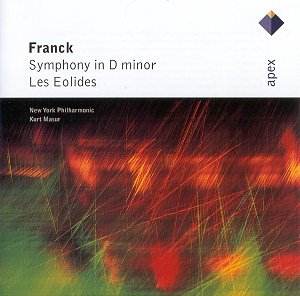
Franck: Symphony in D minor; Les Éolides New York Philharmonic Orchestra / Kurt Masur Recorded live, Avery Fisher Hall, February 1992 WARNER APEX 0927 41372-2 [48:24] DDD — There’s something curiously restrained about this Symphony in D minor under Kurt Masur’s baton — a live production, yes, but with the polished sheen of a studio session. The New York Philharmonic plays with undeniable precision; their ensemble is locked, their intonation immaculate. Yet, the drama — that vital Franckian tension — hovers just out of reach, as if held in check by an invisible hand.
Masur approaches the opening Lento with a gravity befitting the symphony’s solemn introduction, but it never quite settles into the portentous mood one expects. The texture is smooth, yet oddly antiseptic; the darker hues of Franck’s harmonic language feel diluted. When the movement swells toward its climax, the momentum is almost there but falls short by a fraction—less a surge, more a hesitation.
The "finale"’s opening gestures, meant to crackle with energy, come off as “almost” punchy, while the thematic material — that follows is “almost” suave — this persistent near-miss quality is frustrating for a work that demands wholehearted commitment. The second movement is where Masur redeems himself, taking the Allegretto at a tempo that; feels logical and — well — alive, avoiding the common trap of dragging Franck’s refined "scherzo" into lethargy. The rhythm flows with an unforced inevitability, and the woodwind solos shine — especially the clarinet’s poignant, airy lines that float above the orchestra like a breeze teasing autumn leaves.
These moments hint at the symphony’s latent lyricism if only the larger architecture could catch fire. Les Éolides, Franck’s symphonic poem from 1876, stands in contrast to the symphony’s concentrated drama, painting a more impressionistic, Wagner-influenced soundscape. Here — Masur allows a bit more freedom — the players even dances at moments, capturing the swirling, airy character implied by the title (the “spirits of the winds” after all).
The strings shimmer with a lighter touch, and brass colors bloom gently rather than bludgeon. Still, the realization feels too measured; the very airiness Franck conjures seems restrained, as if the ghosts are tiptoeing rather than swirling. The textures are clean but lack the seductive haziness that other interpreters coax from this piece.
Of course, Franck’s symphony has a storied discography — Beecham’s and Munch’s historic recordings loom large, offering a sense of organic fervor and sublime lyricism that Masur’s reading doesn’t quite capture. The New Yorkers, well drilled, might be faultless in execution, but music is not just flawless mechanics; it’s conviction, it’s risk, it’s that leap into the unknown. Here, the risks are hedged, and we’re left with performances that hover tantalizingly close to greatness but never fully land.
The warm acoustics of the concert hall seem to breathe through the recording.
Given the disc’s original full-price release with under fifty minutes of music, its commercial appeal was always going to be limited. At a budget price, it might still serve listeners who crave a clean, lucid Franck with moments of genuine beauty — but it is difficult to recommend this as a benchmark or definitive reading of these works. Masur’s Symphony in D minor and Les Éolides prove, once again, that technical; mastery alone cannot substitute for the elemental force and poetic fire these pieces require.
In sum: a performance of almosts, notable for discipline and polish but lacking in the all-important element of consuming inspiration. For those seeking a Franck symphony that truly stirs the soul, look elsewhere.