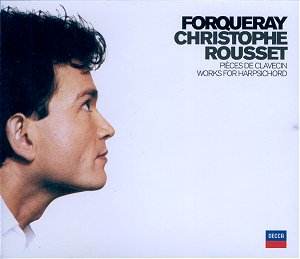
Forqueray: Pièces de Clavecin
Christophe Rousset, harpsichord
Decca 466 976–2 (2 CDs: 148:11)
The vexing question of Jean-Baptiste Forqueray’s filial piety—or lack thereof—has long haunted these pieces. Did the son actually transcribe his father Antoine’s viol music for harpsichord in 1747, two years after the elder Forqueray’s death? Or did he simply compose the whole thing himself, trading on a famous name? We may never know. What we do know is that these suites, whether genuine transcriptions or elaborate fictions, present peculiar problems for the harpsichordist.
The issue is fundamental: music conceived for the bass viol, that most vocal of instruments, doesn’t naturally migrate to the harpsichord’s plucked universe. The viol’s sustained tones, its capacity for dynamic shading, its ability to sing a melody in the tenor and bass ranges—none of this translates comfortably. What we get instead is something awkward, the left hand burdened with melodic responsibilities it wasn’t designed for, the right hand often reduced to decorative filigree. It’s backwards music, in a sense.
Christophe Rousset, whose recordings of Couperin and Rameau have showd considerable finesse, seems oddly at sea here. His tempi rush—not with the excitement of discovery but with something closer to impatience. In the opening movements of the D minor suite, where one wants to savor the dark harmonies, to let the dissonances speak, Rousset hurries past as if late for an appointment. The ornamentation, already thick on the page, becomes a blur of plucked strings rather than expressive inflection.
The Hemsch harpsichord from the Musée de la musique doesn’t help matters. Its lower register—and these pieces live primarily in that register—sounds congested, almost muddy. Listen to “Jupiter,” the final movement of the C minor suite, supposedly a tour de force of virtuosity: what should be brilliant and crystalline becomes a sonic traffic jam, all those rapid notes piling up on each other in the instrument’s bass. Rousset’s fingers fly, certainly, but the rhythm wobbles, the architectural clarity dissolves. One hears effort rather than mastery.
There are moments when everything aligns. The “Sarabande: La DAubonne” from the G minor suite sits higher on the keyboard, and suddenly the Hemsch reveals its considerable charms—a silvery clarity, subtle timbral variations between registers, the kind of sonic refinement one associates with the finest French instrument making. Here Rousset relaxes into the music’s natural flow, ornamentation serving expression rather than overwhelming it. It’s a glimpse of what might have been.
But these are exceptions. Too often the album captures a harpsichordist wrestling with fundamentally unsuitable material on an instrument that magnifies rather than ameliorates the problem. The engineering itself seems flat, lacking the dimensional presence that might have given individual voices more definition. When the left hand carries the melodic burden in the lower octaves, we need to hear it clearly, need to follow its line through the decorative underbrush. Instead everything blurs together.
One suspects Rousset knew he was fighting a losing battle and decided to compensate with velocity and technical display. It’s an understandable strategy but ultimately self-defeating. These pieces, if they’re to work at all on harpsichord, require exactly what Rousset doesn’t provide: patience, spaciousness, a willingness to let the instrument’s limitations become expressive in themselves.
The result is curiously lifeless—technically accomplished, historically informed, and musically inert. Rousset’s considerable gifts as a harpsichordist are poorly served by this repertoire, and his interpretive choices make matters worse. One finishes these two discs with renewed respect for the bass viol and its repertoire, and with the nagging suspicion that perhaps Jean-Baptiste Forqueray’s transcriptions were never meant to stand as independent harpsichord works at all. They remain what they probably always were: a clever marketing scheme that doesn’t quite conceal its essential miscalculation.
Those curious about the Forqueray family’s music would do better to seek out recordings on the viol itself. On harpsichord, even in hands as capable as Rousset’s, it remains stubbornly unrevealing.