Gabriel Fauré: Compilation
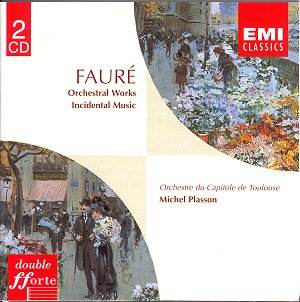
Pelléas et Mélisande (Prelude, “The Spinning Girl,” “Sicilienne,” “Mélisande’s Song,” “The Death of Mélisande”)
Masques et Bergamasques (Overture, Pastorale, Madrigal, “The Sweetest Road,” Minuet, “Clair de lune,” Gavotte, Pavane)
Shylock (Song, Entr’acte, Madrigal, Epithalame, Nocturne, "Finale")
Ballade for Piano and Orchestra (Jean-Philippe Collard, piano)
Élégie for Cello and Orchestra (Paul Tortelier, cello)
Berceuse for Violin and Orchestra (Yan-Pascal Tortelier, violin)
Fantaisie for Piano and Band (Jean-Philippe Collard, piano)
Les Djinns (Ensemble Vocal Alix Bourbon)
Caligula (Incidental music for women’s voices and orchestra, Ensemble Vocal Alix Bourbon)
Pénélope (Prelude)
Orchestre du Capitole de Toulouse / Michel Plasson
Recorded 1979–1980, Halle-aux-Grains, Toulouse
EMI 2 CD CZS 5748402 [137:42]
Michel Plasson’s long-standing association with the Toulouse players—here, on this reissued EMI set—is a sturdy foundation for Fauré’s often elusive orchestral world. He and his band approach the repertoire with a characteristic blend of polish and restraint; there is finesse, certainly, but also a warm, naturalistic sound that avoids the temptation to enshrine Fauré as merely a refined relic. He breathes here, and crucially, he breathes with life.
Take the Pelléas et Mélisande suite: Plasson’s Prelude glimmers with a gauzy shimmer, the strings caressing the harmonies rather than forcing them. And then “The Spinning Girl” — a tiny gem of taut rhythmic energy and silken phrasing — unfolds with hypnotic precision, the woodwinds darting delicately in and out like motes of dust caught in a sunbeam. Frederica von Stade’s “Mélisande’s Song” is the emotional heart of this disc, her mezzo voice tender but never sentimental, hovering on the edge of despair with an affecting, breath-held intimacy.
It’s a rendition that suggests the song’s haunted lyricism rather than simply stating it. The Masques et Bergamasques suite is a delight—each dance number crisp, yet imbued with a languorous undercurrent, most notably in the “Gavotte” with its infectious rhythms and the ever-present Pavane, that quintessential Fauré slow march, which Plasson lets linger with a wistful, almost aching nostalgia. Nicolai Gedda’s contributions are no less impressive here; his “The Sweetest Road” and “Clair de lune” are models of French diction and elegant line, his tenor voice keening with a gentle glow that never overreaches.
These vocal interludes add a rare dimension to suites often recorded purely instrumentally. Shylock—arguably the set’s lesser-known treasure—reveals a different facet of Fauré’s palette. The “Song” opens with brooding strings and subtle harp weaving, a shadowy texture that sets the tone for Gedda’s ardent, nuanced singing.
The “Entr’acte” is unexpectedly robust—almost heroic—its dramatic contrasts underscoring Fauré’s versatility beyond the familiar salon-style elegance. The “"Finale"” sparkles with an operetta-like zest, peppered with pizzicatos that dance on the edge of whimsy. Turning to CD2, the Ballade for Piano and Orchestra, with Jean-Philippe Collard at the keyboard, deserves special mention.
Originally a piano solo, this orchestration is handled with subtlety here; Collard tackles the piece’s technical — challenges with aplomb, balancing the work’s shifting moods—from brooding introspection to a playful, almost mischievous lightness. The textures never become muddy, a testament to both pianist and director in maintaining clarity. Collard’s later Fantaisie bristles with autumnal hues—wistfulness, a touch of turbulence—his touch sensitive to the music’s late-period melancholy.
Paul Tortelier’s cello in the Élégie is a masterclass in mournful restraint. His tone is rich and rounded, each phrase drawn out with a natural, unforced lament. The Berceuse for violin, with Yan-Pascal Tortelier, offers a delicate counterpoint: the violin’s lyricism floats effortlessly over the orchestra, its melody both familiar and freshly cherished.
You can almost hear the rosin dust settling on the strings.
The incidental music to Caligula by Alexandre Dumas provides another intriguing contrast. Fauré here conjures imperial grandeur with fanfares and martial rhythms, yet there’s always a careful balancing act between power and intimacy. The choral writing—Ensemble Vocal Alix Bourbon—alternates between ominous ostinatos and tender, almost fragile vocal lines (“L’hiver s’enfuit”), capturing the drama’s shifting moods with sensitivity.
“Les Djinns,” also featuring this ensemble, is a highlight—its swirling, stormy textures effectively evoke the supernatural spirits of the title, blending shadow and lyricism in a way only Fauré could manage. Finally, the Prelude to Pénélope closes the set on a note of yearning. The orchestral colors here are meticulously shaped; strings and winds echo the fragile hopes of Penelope herself, waiting for her husband’s return.
It’s narrative music with a palpable emotional core. In sum, this compilation serves a dual purpose: it revisits the familiar with a fresh, full-bodied approach and unearths rarities that reveal Fauré’s broader, sometimes darker expressive range. Michel Plasson and the Orchestre du Capitole de Toulouse play with devotion and understanding, supported — by soloists whose performances are notable for their blend of technical command and poetic sensitivity.
There’s an intimacy here that resists grandiosity, revealing Fauré’s music as quietly profound rather than overtly dramatic. For listeners seeking a rounded portrait of Fauré’s orchestral and vocal output—one that; embraces both the canon and the obscure—this 2-CD EMI set remains unhesitatingly recommended. It’s not just a historical document but a living, breathing testament to Fauré’s enduring lyricism and subtle genius.