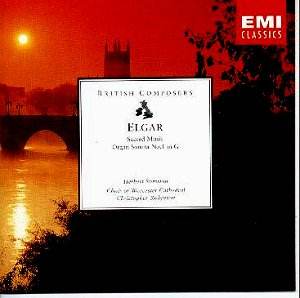
Sir Edward Elgar (1857–1934): Organ Sonata No. 1 in G, sacred works including Ave verum corpus, Ave Maria, Ave maris stella, Vesper Voluntaries (Introduction and "Andante"), “Angelus,” “Give Unto the Lord” (Psalm 29), Te Deum and Benedictus
Herbert Sumsion, organ (Gloucester Cathedral)
Choir of Worcester Cathedral (Harry Bramma, organ)
Christopher Robinson, maestro (choir)
EMI CDM 5 65594 2 [76:10]
Recorded Gloucester Cathedral, January 1965; Worcester Cathedral, March 1969
Produced by Brian B. Culverhouse
It’s a peculiar pleasure to revisit this 1960s EMI anthology of Elgar’s less familiar—but no less stirring—sacred and organ repertoire.
The Organ Sonata No. 1 in G alone could fill the frame of any recital, and here Herbert Sumsion’s Gloucester Cathedral performance is a compelling touchstone. Sumsion, whose career overlapped with Elgar’s twilight years, knew the composer’s idiom intimately—indeed, Elgar’s sardonic pun after Sumsion’s Three Choirs Festival debut still lingers: “what — at the beginning of the week was an assumption is now a certainty.” It’s in that spirit of assured musicianship that Sumsion navigates this sprawling sonata.
The sonata itself—composed in 1892—presents a fascinating study in contrasts. From the outset, its contrapuntal textures demand clarity, and Sumsion delivers with an incisiveness that cuts through the sometimes muddy acoustic one might expect in a Gothic cathedral setting. The majestic, nobilmente themes swell with a measured grandeur, conveying ceremonial dignity without tipping into pomposity.
At the same time, the quieter, almost intimate passages invite reflection—the reverberation of each phrase hangs in the air, suffusing the vast cathedral space with an almost tangible stillness. One hears the organ’s pedal points resonate richly beneath the manuals’ ornate figurations—the kind of — full-bodied, slightly woody tonal palette characteristic of the Gloucester instrument—dipping and rising like gentle waves. Now, the other pillars of this collection—Elgar’s sacred vocal works—were recorded later in Worcester Cathedral, a city indelibly linked to Elgar’s early musical formation as organist at St George’s Catholic Church.
These pieces—Ave verum corpus, Ave Maria, Ave maris stella—are deceptively simple in melodic contour but brimming with heartfelt sincerity. The Ave verum corpus, originally a Pie Jesu, was written in memory of W. A.
Allen, a figure from Elgar’s youth. Elgar himself dismissed it as “too sugary,” but sugar here is of a refined vintage. The choir of Worcester Cathedral, under Christopher Robinson’s sensitive baton, imbues these hymns with an unforced warmth; vibrato — is restrained, diction crisp, and the blend well balanced, lending the music a serene glow rather than saccharine sentimentality.
The two movements from the Vesper Voluntaries—Introduction and "Andante"—offer a striking contrast. The former bursts with processional bravura, brass-like organ stops ringing out with a brisk, ceremonial pulse. The "Andante", by contrast, dips into a contemplative, Schumann-esque lyricism: a hushed elegy — that whispers rather than declaims — the legato lines unfolding with a quiet yearning.
Here the acoustics of Worcester Cathedral—its longer decay time—add a shimmering halo to the softer textures, the notes dissolving gradually like mist. “Angelus,” inspired by Elgar’s visit to Careggi near Florence in 1909, is particularly evocative. The organ voicings conjure the tolling of bells at dusk, with gentle suspensions that mimic the pealing across Tuscan hills.
The choir’s subtle phrasing in “Give Unto the Lord” (Psalm 29) complements this—Elgar’s harmonic language here is robustly Romantic but tempered by a dignified restraint that prevents it from becoming mawkish. The Te Deum and Benedictus (1897) are the album’s grandest choral moments. The choir’s articulation is crisp, and the organ accompaniment alternates between thunderous grandeur and tender sotto voce moments with deft control.
The climaxes swell with true Elgarian fervour—heartfelt and stirring rather than bombastic, underpinned by the organ’s rich, sonorous timbres and the choir’s full-bodied homophony. Finally, O Hearken Thou, performed at the coronation of George V, carries a weighty solemnity. The choir’s reverence is palpable, and even on this disc—now some decades old—the sense of occasion is tangible.
The slow, measured pacing and the organ’s spacious registration perfectly underscore the ceremonial gravity. If one has a quibble, it might lie in the occasionally dated engineering—some moments betray a slight muddiness, especially in the lower organ registers during dense contrapuntal sections. But this is more a function of analogue technology and acoustic idiosyncrasies than realization.
Sumsion and Robinson’s interpretive choices remain fresh and authoritative. In sum, this EMI disc is an invaluable document: a snapshot of Elgar’s sacred and organ works as heard from the perspective of musicians steeped in his world—Sumsion, Robinson, and the Worcester choir. For anyone committed to understanding Elgar beyond the Enigma and Pomp and Circumstance, this recording offers both aural richness and scholarly insight.
The subtle intake of breath before the pianist’s attack.
A rare gem—decidedly recommended.