
Edward German: In Search of a Lost Voice
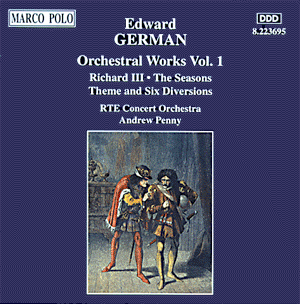
Marco Polo 8.223695 (65:26)
Edward German (1862–1936)
Richard III Overture; Theme and Six Diversions; The Seasons
RTÉ Concert Orchestra/Andrew Penny
One approaches Edward German with a certain wariness these days. Not because the music doesn’t deserve attention—it does, intermittently—but because the Victorian theatrical world that nourished him has receded so completely from our consciousness that we’re left scrambling for context. Who was this man, really, beyond the creator of Merrie England?
This Marco Polo disc, recorded in Dublin’s Taney Parish Centre back in 1994, offers a mixed answer. The Richard III Overture opens with portentous brass—all glowering menace and theatrical swagger—but German can’t quite escape the limitations of his assignment. It’s incidental music writ large, effective enough as a curtain-raiser but lacking the architectural spine that would make it a proper concert overture. The dark D minor gestures pile up without sufficient contrast; one wants Sullivan’s deftness, or at least Stanford’s sense of proportion. Andrew Penny doesn’t try to make it more than it is, which is honest conducting, though the RTÉ strings sound a touch undernourished in the lower registers.
But wait. The Theme and Six Diversions from 1919 reveals something altogether more interesting—a composer of fifty-seven who’d learned a thing or two about orchestral color and formal design. These variations have genuine wit. German’s theme unfolds with a certain Brahmsian dignity, then the diversions spin off in directions both predictable and surprising. The third variation, around the 4’56” mark, anticipates Eric Coates with uncanny prescience—that particular brand of English pastoral sweetness that would dominate light music for decades. Did Coates know this piece? One suspects not, which makes the resemblance all the more curious.
The orchestration here shows real craft. German understood wind timbres—the oboe solos have a plaintive quality that never tips into sentimentality, and the brass writing in the fifth diversion has genuine heft without bombast. Penny and his Irish players respond with affection; the articulation is crisp, the phrasing shapely. The Taney acoustics serve them well—warm but not soupy, with enough presence to let the woodwind detail register.
The Seasons, however, presents problems. German calls it a “symphonic poem,” which raises expectations the music can’t quite fulfill. “Spring” begins promisingly enough with fluttering figurations and a certain Mendelssohnian lightness, but then clouds gather—literally and metaphorically. The scoring grows heavier, the textures denser, and one loses the thread. Is this still spring, or have we stumbled into some Tchaikovskian tempest?
“Summer” offers the disc’s most bizarre moment: around 5’03”, German produces a passage of such startling modernity—all menacing brass and angular rhythms—that Bernard Herrmann’s score for North by Northwest seems to echo across the decades. Did Herrmann know German’s work? Almost certainly not. Yet there it is: the same psychological tension, the same orchestral palette. These moments of inadvertent prophecy fascinate more than the conventional pastoralism surrounding them.
“Autumn” sags into solemnity. The liner notes speak of tight structural connections between movements—motivic threads linking back to spring and summer—but I confess I can’t hear them clearly. Perhaps a score would reveal what the ear misses. Or perhaps German’s thematic integration isn’t as thorough as his admirers claim. “Winter” recovers some ground with a majestic opening and a surprisingly robust dance episode—Christmas revels, one imagines—but by this point the suite’s lack of stylistic focus has become evident.
The real puzzle is why German, so adept at theatrical timing and melodic invention, should produce something as uneven as The Seasons. The piece sounds uncertain of its identity: too heavy for impressionistic scene-painting, too episodic for symphonic argument. The orchestration often suggests Russian models—Glazunov, perhaps, or early Rachmaninoff—rather than anything distinctly English. This wasn’t German’s métier. He needed the stage, needed dramatic situations to galvanize his invention.
D.R. Hulme’s liner notes provide exhaustive detail but leave crucial questions unanswered. What was German’s initial training before the Royal Academy? (Organ, one assumes, given his later facility with registration-like orchestral colors.) Why did he produce so little orchestral music if he harbored symphonic ambitions? The comparison with Sullivan hovers over everything: both theater composers, both capable of greater things, both finally trapped—or liberated?—by popular success.
The performances are professional without being revelatory. Penny knows this repertoire, clearly, and the RTÉ players give him accurate, committed work. But one wishes for more personality in the string tone, more bite in the climaxes. The engineering captures everything with scrupulous balance—perhaps too scrupulous; a touch more presence in the brass might have helped the Richard III Overture’s dramatic argument.
For those exploring British music at the turn of the century, this disc offers valuable evidence—though not, I think, a strong case for German’s stature. The Diversions alone justify the purchase: tight, inventive, beautifully crafted. The rest? Interesting documents of a talent that flowered best in the hothouse of the theater, and wilted somewhat in the concert hall’s harsher light.
