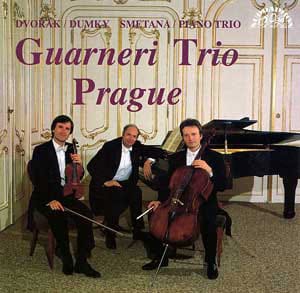
Antonín Dvořák (1841–1904), Piano Trio in E minor, Op. 90 Dumky; Bedřich Smetana (1824–1884), Piano Trio in G minor, Op. 15
Guarneri Trio Prague
Recorded Domovina Studio, Prague: September and November 1991
Label: SUPRAPHON 11 1561-2 [56’12”] (CD)
The warm acoustics of the concert hall seem to breathe through the recording.
The Guarneri Trio Prague’s 1991 recording of Dvořák’s Dumky and Smetana’s Piano Trio is a document of early maturity—rough around the edges in places, yet brimming with unmistakable passion and authority.
It’s a sound that, while perhaps lacking the lush bloom and acoustic warmth one might crave, offers a fascinating glimpse into interpretative choices that would evolve markedly in their later Supraphon sessions. The Dumky, Dvořák’s opus of melancholy and caprice, bursts forth here with a rhythmic urgency that is at times almost breathless. The trio’s tempi are consistently on the brisker side, sometimes skirting the edge of urgency without quite tipping into haste.
This briskness, paired with a relatively lean recording texture, accentuates the scherzando "scherzo"-like contrasts in the work’s episodic movements. The piano—in Ivan Klánský’s hands—cuts through with incisive clarity, though the strings occasionally sound a touch pinched, as though the resonance is held in check by the Domovina’s somewhat sterile acoustic. Cenek Pavlík’s violin playing—especially in the third movement "Andante"-Vivace non troppo of the Dumky—reveals a performer caught between youthful expressiveness and emerging restraint.
His left hand’s subtle intensifications lend a succulent richness, but one senses an overemphasis bordering on theatricality. Indeed, this production captures an artist still wrestling with the balance between visceral display and structural coherence. That said, the energy and texture here sometimes feel more immediate than the trio’s subsequent, more polished 1997 campaign.
Smetana’s Piano Trio, a deeply personal and — well — tempestuous work born from tragedy, demands a steady hand—both emotionally and technically. The Guarneri’s reading navigates the difficult terrain between raw feeling and architectural clarity with commendable success. The piano and strings find a tense equilibrium, never allowing the work’s inherently splintering elements to fragment completely.
The opening movement’s dark undercurrents are conveyed with muscular conviction, the cello’s mournful lines resonating with a restrained but palpable grief. Yet the acoustic here—somewhat cold and lacking in bloom—at times muffles the full sweep of Smetana’s lyricism. It is a studio environment that feels too clinical for the work’s impassioned outbursts and — well — anguished silences.
One longs for a richer, more enveloping soundstage to fully immerse in the trio’s haunted narrative. That said, the Guarneri’s collective precision and subtle interplay manage to generate considerable heat despite these limitations. Comparing this to their 1997 Supraphon re-recording reveals an insightful evolution.
The later session exhibits a more polished, balanced sound and — well — a more nuanced approach to pacing—particularly — in the Dumky’s slow movements, where a tighter structure and inward subtlety supplant the earlier emotive excesses. But this 1991 snapshot, for all its occasional roughness, captures something a touch more urgent and alive. In sum, this Guarneri Trio offering is no mere historical curiosity.
It stands as a testament to artists in the midst of formative reflection, wrestling with works so deeply entwined with national identity and personal loss. The recording’s flaws—uneven acoustics, sometimes glacial timbres—are to some extent outweighed by the trio’s commitment to emotional truth and rhythmic vitality. For listeners willing to embrace a somewhat lean sound and revel in a less polished but impassioned interpretation, this remains a recording of considerable character and scholarly interest.
A nuanced, occasionally uneven yet ultimately gripping execution — a worthy if not definitive entry in the discography of these central Czech masterworks.