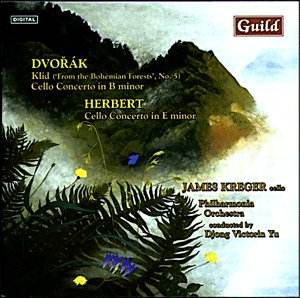
A Bohemian and an Irishman Walk into New York
The pairing of Dvořák’s Cello Concerto with Victor Herbert’s Second makes more sense than it might appear—these works emerged from the same Manhattan hothouse in the mid-1890s, when both composers were navigating the peculiar cultural crosscurrents of Gilded Age New York. Herbert, principal cellist of the Metropolitan Opera, sat in the New York Philharmonic when they premiered the New World Symphony. Within months he’d written his own concerto. Dvořák heard it, reconsidered his long-standing resistance to the cello as solo instrument, and composed what became the repertoire’s cornerstone.
James Kreger and maestro Djong Victorin Yu treat this historical connection with variable success. The Fairfield Hall acoustic—serviceable but hardly sumptuous—doesn’t help matters. There’s a peculiar recession in some orchestral sections, as if the engineers couldn’t quite decide where to place their focus. First violins disappear just when you want to hear those counter-melodies threading through Dvořák’s first movement development. Meanwhile certain pizzicati leap out with startling proximity.
But let’s start with what works.
Kreger possesses a genuinely luminous instrument—warm in the lower registers without that tubby quality that plagues some modern cellos, singing in the upper without turning glassy. His Klid (the orchestrated “Silent Woods”) captures the piece’s wistful nostalgia. This is music Dvořák wrote thinking of Bohemian forests, then orchestrated in Manhattan while homesick; Kreger finds that double exile in his phrasing, letting the melodic line unfurl with a kind of patient sorrow. The Philharmonia’s woodwinds answer with elegant restraint.
The concerto proper proves more problematic. That late first-movement entry—where the cello must emerge from the orchestral tumult with absolute authority—sounds tentative. Kreger seems to creep in rather than stride. The bars immediately following lack the command this music demands. It’s the difference between a cellist playing at the orchestra and one playing with it—or better yet, against it in that productive tension great concerto performances require.
Yet something curious happens as the movement progresses. Kreger’s romantic passages—those moments where Dvořák’s melodic gift simply overwhelms—bloom with genuine emotional nuance. There’s a vulnerable quality to his phrasing in the second subject that Julian Lloyd Webber’s more extroverted approach (in the Chandos recording with Neumann) doesn’t quite capture. Lloyd Webber plays with greater security, certainly. But security isn’t everything.
The slow movement brings Kreger’s strengths into focus. He understands the music’s consolatory function—this is the movement where Dvořák quotes his own song “Lasst mich allein,” written for his dying sister-in-law Josefina. The quotation appears around 3’36” (is it coincidence it echoes the New World? Dvořák’s mind worked in mysterious ways). Kreger doesn’t sentimentalize but he doesn’t shy from sentiment either. That’s a tender balance.
The "finale"’s march rhythms find Yu at his most persuasive. He drives the music forward without brutality, though one wishes the Philharmonia had more tonal heft in the brass. This isn’t the Berlin Philharmonic under Karajan—that legendary 1968 disc with Rostropovich remains the benchmark for orchestral sumptuousness. But then again, Karajan’s approach can feel over-upholstered. Yu’s leaner textures let you hear the architecture more clearly, even if some corners need better lighting.
The Second Cello Concerto occupies that twilight zone between competence and inspiration. Herbert knew his instrument—he’d played it professionally for years—and he understood late-Romantic rhetoric. The opening “"Allegro" impetuoso” asks a question (so Benjamin Folkman’s notes tell us), which the orchestra answers. Fair enough. But what a pedestrian question! That opening motif gets worked over with Teutonic thoroughness, and after the third or fourth permutation you start wishing Herbert had found another idea to develop.
The “Lento” offers respite. Here Herbert’s melodic gift—he’d later write operetta tunes that became American standards—emerges more persuasively. Kreger plays this movement with touching simplicity, avoiding the vibrato excesses that can make Romantic slow movements cloying. The Philharmonia strings finally get to do something interesting, and they respond with warm-toned support.
In the "finale", Kreger’s interpretation diverges most sharply from Lloyd Webber’s EMI recording (coupled with the Sullivan concerto under Mackerras). Lloyd Webber plays lighter, more vivaciously. Kreger takes a weightier approach—Yu is actually slower by fifteen seconds or so—which emphasizes the movement’s structural logic at the expense of its surface charm. It’s a defensible choice, though I’m not entirely convinced by it. This music wants to sparkle a bit more than it does here.
The question hovering over this release is whether Herbert’s concerto deserves the attention. It’s gracefully written, certainly, and it needs “a few hearings to fully appreciate its construction” (as the original reviewer diplomatically noted). After several hearings, I’d say it reveals itself as exactly what it is: the work of a skilled craftsman who lacked Dvořák’s genius for memorable melodic invention. There’s nothing wrong with that. We can’t all be geniuses.
Kreger plays both concertos with evident commitment and considerable technical facility. His tone—that warm, focused sound—remains his greatest asset. If his interpretations don’t quite reach the top tier, they’re honest and musicianly. The Philharmonia under Yu provides adequate support, though the recorded sound does them no favors.
For the Dvořák, Rostropovich/Karajan on DG remains essential, and Lloyd Webber/Neumann offers modern sound with interpretive insights this reading sometimes misses. For the Herbert, Lloyd Webber/Mackerras still holds the field—though frankly, one good recording of this work is probably sufficient for most collectors.
This disc fills a gap. Whether that gap needed filling is another question entirely.