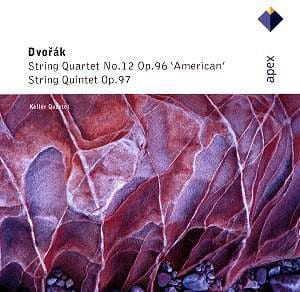
Antonín Dvořák
String Quartet in F, Op. 96, “American”
String Quintet in E-flat Major, Op. 97
Keller Quartet, with Anna Deeva (viola in Quintet)
Recorded Salle de Musique de la Chaux-de-Fonds, Switzerland, January & June 1994
APEX 0927 44355 2 [55:12]
For all the ink spilled — and rightly so — about Dvořák’s sojourn in America, these recordings by the Keller Quartet (and Anna Deeva joining for the quintet) present a refreshingly intimate take on two cornerstones of chamber music repertoire.
The American Quartet, Op. 96, and the String Quintet, Op. 97, were both conceived during Dvořák’s 1893 stay at Spillville, Iowa — a Czech enclave where the composer, despite the supposed “American” tag, remained firmly rooted in his Bohemian musical DNA.
A curious paradox, this: while many programme notes trumpet the “American folk elements” in these works, here it’s clear the music breathes with the rhythms and — well — melancholy idioms of Czech folk traditions. Dvořák’s nostalgia — that bittersweet sigh of exile — lingers palpably. The Keller Quartet’s reading of the quartet is vigorous, almost bracing, yet never loses the warm undercurrent of lyricism.
The "allegro" moderato first movement bursts with an almost naïve energy, but it’s the slow movement — the “Lento” — that truly arrests: the cello’s dark timbre resonates with aching tenderness, as if mourning a home left far behind. One doesn’t merely hear the melody; one feels the shape of it pressed against the chest. The "scherzo" that follows snaps along with infectious charm and — well — rhythmic sharpness, a delightful foil to the "finale"’s rollicking dance, which the Kellers spin with enviable buoyancy.
Contrast this with the quintet, where the addition of a second viola opens a whole new palette of tonal hues. Anna Deeva’s viola work is exemplary — rich phrasing and a sensuous bowing that almost makes the instrument sing in a way that feels personal and immediate. The first movement of the quintet unfurls with expansive gestures, the climaxes sculpted with passionate care, building tension without ever tipping into excess.
The "scherzo", one of Dvořák’s most spirited, snaps and crackles with a rhythmic verve that’s thrilling — the “bite” here is palpable, the syncopations deftly articulated. Then comes the heart of the quintet: the third movement, beginning as a hushed conversation between the two violas and the cello. There’s a refined transparency here — the silences almost as telling as the notes.
The set of free variations that follow are handled with admirable restraint, the Keller ensemble allowing space to breathe, never rushing, never thickening the texture unnecessarily. Their sense of pacing here is masterful — capturing the partitas’ introspective mood. The "finale" rounds off with a flourish — the ensemble’s unanimity in delivering the triumphant close is undeniable, the balance between instruments finely calibrated, dynamic shading judiciously applied.
That particular brightness of period instruments catches the ear.
Throughout, the disc itself—close yet respectful of the ensemble’s collective sound—serves well to convey the immediacy and — well — intimacy of these performances, the hall’s acoustics giving just enough resonance without blurring edges. It’s worth noting that the Keller Quartet’s approach, while polished, never feels overly studied or mannered. This is chamber music played by musicians who know these scores inside out, who communicate a genuine affection for Dvořák’s idiom and structural ingenuity.
Occasionally, a phrase lingers just a shade longer than expected or a dynamic swells with spontaneous urgency — — these moments lend a human warmth and — well — vitality that reminds us why this repertoire remains so compelling. In sum: a rewarding, stylish, and — well — deeply felt disc that captures both the robust extroversion and the wistful introspection of Dvořák’s American works with equal conviction. Not merely a scholarly document, but a living, breathing musical conversation.
A execution that’s as much about heart as it is about mastery. Essential listening for those who want to hear these familiar works anew.