# Duphly’s Elegant Miniatures—When the Room Overwhelms the Instrument
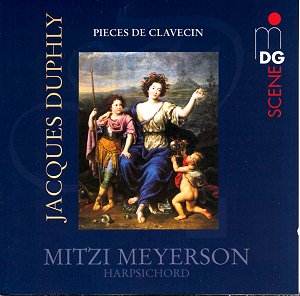
Jacques Duphly: Pièces de Clavecin**
Mitzi Meyerson, harpsichord
MDG 605 1068–2 [62:27]
Jacques Duphly remains one of those composers who haunt the margins of the French harpsichord repertoire—not quite Couperin, certainly not Rameau, yet possessed of a distinctive voice that deserves more than the occasional anthology appearance. He died on July 15, 1789, the day after the Bastille fell, which makes for tidy biographical symmetry if nothing else. His entire output amounts to just fifty-two pieces, published across four books between 1744 and 1768. He held no court position, survived on teaching and performing, and left us music that captures the twilight of an entire aesthetic world.
Mitzi Meyerson has assembled an intelligent cross-section here, drawing from all four books to reveal Duphly’s range—such as it was. The programming moves cleverly between character pieces, dance movements, and those curious hybrid forms that French composers of the period loved to cultivate. “La Forqueray” pays obvious homage to the great viol dynasty; “La de Vaucanson” presumably honors the famous automaton-maker (what a period, when a harpsichord piece could be named after an engineer). These are urbane miniatures, salon music in the best sense, designed to flatter both performer and listener without making excessive demands on either.
Meyerson plays Keith Hill’s copy of a Taskin instrument—on paper, an ideal choice for this repertoire. Hill’s instruments have earned considerable respect, and the Taskin model, with its sophisticated buff stops and careful voicing, should navigate Duphly’s ornamental thickets with clarity and grace. In the simpler textures, particularly the paired Menuets from the third book, you can hear what this instrument is capable of: a singing treble, well-defined bass registers, and that particular silvery bloom that distinguishes good French harpsichord tone from merely competent German or Flemish specimens.
But then there’s the acoustic.
The Kammermusiksaal in Friedenau has apparently swallowed this harpsichord whole. MDG’s engineers pride themselves on capturing “natural” sound without electronic manipulation, which is admirable in principle—except when the principle collides with practical disaster. The opening Chaconne arrives wrapped in a sonic haze that obscures Duphly’s carefully wrought detail. You can hear that Meyerson is doing something interesting with the ornaments, that her rhythmic inflections are probably quite subtle, but the information reaches you through several layers of acoustic gauze. It’s like viewing a Watteau through frosted glass.
The problem intensifies in the more densely ornamented pieces. “La de Belombre” should sparkle with virtuosic display—it’s one of Duphly’s most technically demanding works, full of rapid passages that require absolute clarity to make their effect. Instead, everything blurs together, the notes piling up in that over-resonant space until individual lines lose their definition. Meyerson’s craft seems secure, her musical instincts sound, but we’re forced to take much of this on faith.
When Duphly writes more simply—the Allemande from the first book, for instance—the disc’s flaws recede somewhat. Here the longer note values and less frenetic ornamentation allow the ear to penetrate that unfortunate reverb. Meyerson shapes the phrases with genuine feeling, finding the melancholy undertow in Duphly’s elegant surfaces. The interpretation suggests an artist of considerable refinement, someone who understands that this music’s power lies in nuance rather than rhetoric.
The more I listen, the more frustrated I become. Duphly’s music isn’t profound—let’s be honest about that—but it possesses real charm and considerable craft. These pieces represent a genuine if minor tradition, and they deserve to be heard in circumstances that allow their qualities to register. Meyerson has clearly thought deeply about this repertoire, programmed it intelligently, and brought appropriate stylistic awareness to her performances. The Hill instrument sounds like it could be magnificent in the right acoustic.
But that acoustic isn’t here. The disc ultimately fails not through any musical deficiency but through simple engineering misjudgment. One imagines the same performances in a drier room, captured with closer microphone placement, and the results would be entirely different—possibly distinguished. As it stands, this remains a frustrating near-miss, a recording that hints at excellence while consistently undermining itself. Duphly and Meyerson both deserved better.