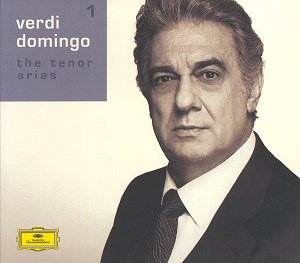
Domingo’s Verdi: The Monument and Its Cracks
Here’s the thing about thorough editions—they expose everything. Deutsche Grammophon has assembled a four-disc monument to Plácido Domingo’s Verdi odyssey, covering all twenty-eight operas with an almost archaeological thoroughness. The packaging alone announces ambition: hard-backed booklet (yes, actually hard-backed), lavish color photographs, 160 pages of texts in four languages, individual sleeves for each disc. It’s the sort of presentation that whispers “definitive” before you’ve heard a note.
And when those notes come from the earlier recordings—Kleiber’s Traviata, Abbado’s Aida, Karajan’s Ballo—you understand why someone thought to build this temple. The “Se quel guerrier io fossi” from the Abbado Aida remains astonishing: those high notes not merely hit but inhabited, the voice darkening and brightening with the text’s shifting moods. Listen to how he shapes “Celeste Aida“—the diminuendo on the final phrase executed with such control that you forget to breathe. This is Domingo at perhaps thirty-five, the voice in its prime bloom, capable of anything.
The two Macduff arias from his 1976 Abbado Macbeth show what made him indispensable. Here’s a relatively ungrateful role—Verdi hadn’t yet learned to write for tenors with the generosity he’d later lavish on Manrico or Radamès—but Domingo finds colors in “Ah, la paterna mano” that I’ve not heard from anyone else. The line is pure, the Italian idiom completely assimilated (remarkable for a Spanish tenor), the legato seamless.
The new recordings made for this edition—some hundred minutes of music, we’re told—present a different singer. Not a bad one, mind you. Domingo at sixty is still Domingo, which means he’s better than most tenors at any age. Yet juxtaposition proves brutal. The freshly recorded arias from Stiffelio, Aroldo, Alzira, I due Foscari—these lesser-known works that presumably justified the whole enterprise—reveal a voice that no longer quite obeys.
Take the Stiffelio excerpt with Tamayo and the Madrid orchestra. The role of Stiffelio, that peculiar Protestant minister whom Verdi tried to salvage as Aroldo, requires sustained lyric intensity. What we hear instead is a tenor managing, calculating, conserving. The top notes arrive safely but without the old ping, the old freedom. There’s a slight flattening of color, a narrowing of the timbral palette. The voice still commands respect—the musicianship, the decades of experience, the sheer intelligence of the phrasing—but the instrument itself shows its age.
I kept jumping between discs, ignoring Deutsche Grammophon’s curious sequencing (maximum playing time apparently trumped chronological or aesthetic logic). From the 1970 Mehta Trovatore—that ringing “Di quella pira” with its interpolated high C—to the 2000 Gergiev sessions in Baden-Baden. The contrast is unavoidable and, frankly, a bit cruel to the later Domingo.
The Gergiev collaborations, which form the bulk of the new material, present their own problems. Gergiev, for all his Verdi enthusiasm, conducts with a certain metric looseness that doesn’t always serve the music. His Mariinsky forces sound scrappy in the I Lombardi excerpts, the strings thin in the Vespri Siciliani. When you’re already asking a sixty-year-old voice to tackle ungrateful music, indifferent accompaniment doesn’t help.
Yet scattered through these four discs are reminders of why Domingo matters. The “Dies irae” from Bernstein’s Requiem—not a tenor aria proper, but thrilling nonetheless. The Don Carlos material with both Abbado and Barenboim, showing how differently he approached the role over the years. “O tu, Palermo” from the French Vêpres (wait, that’s a baritone aria—what’s Domingo doing with it? Never mind, he sings it beautifully). The Giulini Rigoletto, where the Duke’s music gets treated with a seriousness that almost seems perverse but absolutely works.
Robert McKechnie’s original liner notes—reproduced here with all their quirks intact—make a valid point: most listeners don’t need arias from Oberto or Un giorno di regno. These early Verdi works are early for good reason. Including them creates a completist’s document rather than a greatest-hits compilation, and I’m not convinced that serves either Domingo or the general public.
What we have, then, is a monument with visible cracks. The earlier recordings justify the price alone—these are performances that belong in any serious Verdi collection. But the new material, recorded explicitly for this edition, often reveals more than it illuminates. We hear a great singer in his seventh decade tackling repertoire he might better have left alone, or at least recorded fifteen years earlier.
Harvey Sachs’s essay promises that we can “observe the astonishing development” of Verdi through these recordings. Perhaps. What we actually observe is the career arc of a tenor who conquered nearly everything Verdi wrote, sometimes multiple times, and who kept conquering even when the voice began its inevitable decline.
For Domingo completists, this set is essential. For those seeking an introduction to Verdi’s tenor writing, I’d suggest a more carefully curated selection—perhaps the classic recordings on two discs, skipping the archaeological expedition through the early operas. The paradox of thorough editions: they include too much to be perfect, but that excess itself tells a story. This one tells the story of ambition meeting mortality, and not always winning.