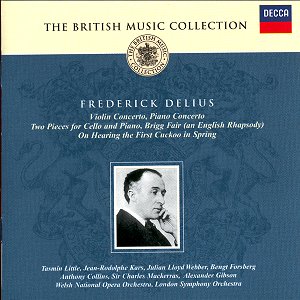
Frederick Delius (1862–1934): Violin Concerto; Piano Concerto; Two Pieces for Cello and Piano (“Caprice” and “Elegy”); On Hearing the First Cuckoo in Spring; Brigg Fair (An English Rhapsody)
Tasmin Little (violin) / Welsh National Opera Orchestra / Sir Charles Mackerras (cond.) [Violin Concerto, 1991, digital]
Jean-Rodolphe Kars (piano) / London Symphony Band / Alexander Gibson (cond.) [Piano Concerto, 1969, analog]
Julian Lloyd Webber (cello) / Bengt Forsberg (piano) [Two Pieces for Cello and Piano, 1996]
Welsh National Orchestra / Sir Charles Mackerras (cond.) [On Hearing the First Cuckoo in Spring, 1990]
London Symphony Orchestra / Anthony Collins (cond.) [Brigg Fair, 1953, mono]
DECCA British Music Collection 2CDs 470 190-2 [77:25] Budget Release
Delius’s musical world—like a half-glimpsed dream from a hazy English summer afternoon—unfolds here with remarkable intimacy and charm. This compilation, drawn from a broad span of recorded history, from Collins’s moody mono of Brigg Fair to Mackerras’s lucid, shimmering performances, offers a patchwork of the composer’s longing for landscape, lyrical panache, and that distinctive blend of impressionism and pastoral reverie. Tasmin Little’s realization of the Violin Concerto is, quite simply, a revelation.
Right from the opening phrase—a thread of yearning, almost aching tenderness—her bow caresses the strings with a mix of warmth and — well — precision that breathes life into Delius’s elusive melodies. The concerto itself, a single continuous movement, flows without artifice, guided by an elegant architecture that never calls attention to itself but invites sustained listening. Little’s cadenza, finely balanced between technical brilliance and emotional depth, is not a mere display of virtuosity but a true distillation of the concerto’s poetic essence.
The orchestral tuttis under Mackerras—fleet yet rich—paint a vibrant but never overpowering canvas, allowing the violin’s “voice” to emerge with pellucid clarity. The final allegretto dances with a rustic charm, a lively pulse that feels both celebratory and intimate—a fitting close to a concerto that never seeks grandiosity but touches instead the heart’s subtle corners. Turning to the Piano Concerto, the late 1960s recording with Jean-Rodolphe Kars and Alexander Gibson dates itself in sonic texture but not in spirit.
That particular brightness of period instruments catches the ear.
This concerto, often overshadowed by more mainstream Romantic repertoire, deserves reconsideration. Its gentle pastoral opening theme—almost a nod to Grieg’s fondness for nature—is rendered with a nostalgic glow. Kars’s playing is no mere technical exercise; he discerns the concerto’s dualities—moments of lyrical innocence contrasting with darker, more brooding passages.
Particularly effective is his touch in the pianissimo dialogues, where the piano’s whisper intertwines with the orchestra’s hushed winds and strings. The single-movement form, a revision from the original three, lends a continuous narrative sweep, yet the architecture remains transparent. The concerto’s final forte flourish, a moment of heroic affirmation, is delivered with conviction rather than bombast.
The Two Pieces for Cello and Piano, “Caprice” and “Elegy,” are haunting miniature portraits from Delius’s final years, written under the shadow of blindness and paralysis. These intimate works—fragile and poignant—speak volumes about the composer’s inner turmoil and resilience. Julian Lloyd Webber and Bengt Forsberg bring a tender empathy to these pieces, with Lloyd Webber’s cello voice seamlessly reflecting the music’s melancholic yearning and brief flickers of joy.
The “Caprice,” with its rippling piano figuration, recalls once again the Grieg influence, — but it also suggests a fleeting dance of light across a shadowed landscape. The “Elegy” is a study in contrast; despair and a glimmer of hope alternate, unfolding with a natural spontaneity that betrays no artifice. No Delius gathering would be complete without On Hearing the First Cuckoo in Spring, a beloved tone poem from 1912 that embodies the composer’s most direct evocation of English pastoralism.
Mackerras’s 1990 recording with the Welsh National Orchestra captures the work’s folkish simplicity and gentle melodic contours with a clarity that feels fresh rather than rehearsed. The orchestral colors shimmer—flutes and harps evoking birdsong and the early morning light—yet there is a — wistful undercurrent, perhaps a homesickness, as if Delius’s expatriate heart is listening for a distant call. Finally — the mono release of Brigg Fair conducted by Anthony Collins with the London Symphony Orchestra is a vintage gem.
There’s an old-world charm in the birdsong-like opening sequence, a pastoral evocation that seems to invite the listener into a half-remembered landscape. Collins’s interpretation is idiosyncratic, perhaps a little slower and more reflective than some modern readings, allowing the horn’s haunting solo to linger, almost as a voice beyond time. The concluding orchestral tuttis fade with a palpable sense of sunset—music dissipating into silence like evening mist.
The sonic constraints of mono sometimes clutter the texture, yet the performance’s integrity shines through, unblemished. —
This DECCA British Music Collection release offers a compelling portrait of Delius’s idiosyncratic genius—a composer whose music requires patience, but rewards with moments of exquisite lyricism and profound intimacy. The Scandinavian echoes, the pastoral sensibility, the lyrical fluidity: all coalesce here in performances that range from the vibrantly immediate to the quietly reverent.
Tasmin Little’s Violin Concerto alone justifies this compilation’s existence, but the inclusion of the lesser-heard piano and cello works enriches the picture immeasurably. For anyone seeking to understand the gentle complexity and elusive beauty of Delius’s oeuvre, this is an essential acquisition. Not perfect, not pristine, sometimes uneven yet always deeply musical—just like the composer himself.
Unhesitatingly recommended.