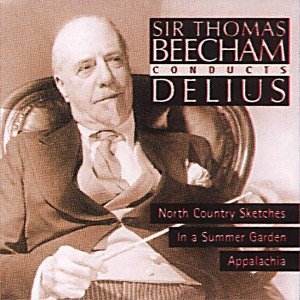
Frederick Delius North Country Sketches, In a Summer Garden, Appalachia Sir Thomas Beecham, Royal Philharmonic Orchestra Recorded: February 14, 1949 (North Country Sketches), October 27, 1951 (In a Summer Garden), October–December — 1952 (Appalachia) Label: Sony SMK89429 (reissued by Naxos) Duration: 67:34 — This disc is a fascinating historical document as much as it is a musical experience—and quite a vivid one at that. Beecham’s recordings of these Delius scores, made in the twilight of his long association with the composer’s works, have a certain gravitas born of finality. None were recorded later by Beecham in stereo; these are his last readings, glimpses into — a personal Delius world that he helped define for British audiences in the 20th century.
First, North Country Sketches (1949). The album opens with this pastoral symphonic poem, quietly radiant yet imbued with a certain misty melancholy—no alpine; horns here, but rather the damp gusts and sprawling moorland airs of Yorkshire, a region Delius never quite abandoned. Beecham’s pacing resists rush; it breathes, almost hesitates, allowing the harmonies to unfurl like fog across untamed fields.
The restored woodwind semi-quaver at the outset of the final movement — “The March of Spring,” — is a tiny yet telling detail—almost imperceptible, but it reanimates the phrase as Delius intended. It’s a subtle restoration that sharpens our sense of continuity in the score’s cyclical nature. In comparison with Beecham’s 1959 broadcast version, this 1949 studio execution is more atmospheric—less hurried, allowing the slow-building tonal colors to seep into the listener’s ear.
The Royal Philharmonic here is responsive, with a warmth and polish that a modern recording might lack, but which—paradoxically—feels closer to the lived-in woods and winds of England than a crystal-clear, digital capture. The band’s strings occasionally hover on the edge of vibrato, a slight tremble that suggests the chill of northern air. This is not mere nostalgia; it’s a lived experience, rendered in sound.
In a Summer Garden (1951) follows, a score intimately tied to Delius’s later life at Grez. The music’s shimmering textures and delicately interwoven motifs evoke the languorous flow of the River Loing and the garden’s dappled light. Beecham here balances delicacy with drive—no aimless drifting.
The string section’s lyrical lines float with a natural inflection, the woodwinds punctuating with bird-like clarity. There’s a crystalline quality to the production—without a hint of artificial enhancement—that serves the music’s impressionistic brushstrokes. Unlike some later interpretations that indulge in a languorous stretch, Beecham keeps the music moving, never allowing it to slip into languor.
The effect is a vivid snapshot, not a dream. Appalachia (1952), the longest and perhaps the most complex piece here, offers another kind of landscape: the American South, filtered through Delius’s late-Romantic sensibility and his firsthand experience managing a Florida orange grove. The score’s chromatic language and lush harmonic palette conjure the oppressive heat, the swamps, the tangled Spanish moss—all vivid as a memory half-remembered.
Beecham’s reading is sensitive, alive to the score’s shifting moods—sometimes tender, sometimes broodingly dark. The six-eight cello variation in D minor, returning near the end, is a haunting moment, its melancholy underscored by the ethereal high strings that Eric Fenby so evocatively described as the “mysterious peace of Solano Grove.” One can almost smell the humid air and taste the heavy sweetness of magnolias in bloom. Why Appalachia remains underperformed is a puzzle.
Its narrative quality and evocative scoring make it ripe for more frequent revival. Yet Beecham’s championing of the work—his advocacy born of personal conviction—lends this recording a peculiar authenticity. His tempi are judicious, avoiding excess while never sacrificing expressive intensity.
The maestro’s presence feels palpable even in this studio setting.
The Royal Philharmonic responds beautifully to the subtle shifts: the brass muted just enough — to suggest distant plantation music, the woodwinds fluttering like insects in the sultry heat. Sound quality, for recordings made in the late 1940s and early 1950s, is remarkably good here—especially in comparison to earlier, more heavily processed releases. The restoration on this Sony/Naxos release brings out a warmth and clarity that allows one to appreciate the fine gradations of Beecham’s interpretation: the swelling string crescendi, the tender interplay of harp and flute, the understated brass fanfares.
There is texture, depth—never brittle or thin. For those familiar with Sir Charles Mackerras’s stereo interpretations on Argo and — well — Decca, this set offers something else altogether—not a crisper or more modern sound, but a more intimate one, the sound of a lifelong Delius devotee shaping the music with a painter’s touch. Beecham’s approach is not without flaws—his phrasing sometimes verges on the mannered, and a few passages could benefit from a less old-fashioned vibrato—but these are minor quibbles against the overall commitment and idiomatic flair he brings.
In sum, this collection is indispensable for anyone seeking to understand Delius’s music as it was heard and loved in the mid-20th century. Beecham’s readings remain touchstones, full of character and a certain human warmth that no digital polish can replicate. At a bargain price and with restored sound, this release is a vital reminder of Delius’s unique voice—and of Beecham’s irreplaceable role as its interpreter.