C.P.E. Bach: Sonatas, "Rondo"s, and Fantasies
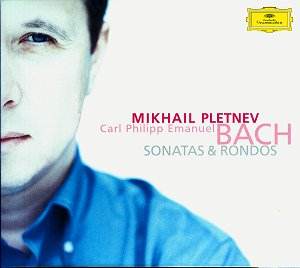
Mikhail Pletnev, piano.
Deutsche Grammophon 459 614–2. Recorded 1998. Released 1999. Compact disc.
Mikhail Pletnev has always been something of an enigma—a pianist who can tear through Prokofiev with ferocious clarity one moment, then turn around and make you reconsider everything you thought you knew about eighteenth-century keyboard music the next. This C.P.E. Bach disc, recorded in 1998 but sounding utterly fresh, belongs firmly in the latter category. It’s the kind of playing that makes doctrinaire period-instrument advocates squirm a bit in their seats, because Pletnev refuses to acknowledge that a modern Steinway can’t speak this idiom with complete authority.
The program—six sonatas, three "rondo"s, and a concluding "Andante" con tenerezza—comes from Carl Philipp Emanuel’s Berlin and Hamburg periods, that fascinating stretch when the eldest Bach son was forging an intensely personal language that his contemporaries found bewildering and we, with hindsight, recognize as prophetic. The Sonata in G Minor that opens the disc announces Pletnev’s intentions immediately: this will be neither a re-creation of fortepiano sonorities nor a romanticized appropriation. Instead, he finds a middle path that shouldn’t work but does—brilliantly. The opening "Allegro" has all the rhetorical abruptness, the sudden gear shifts of affect that made C.P.E.’s music so controversial. One moment we’re in galant territory; the next we’ve lurched into something approaching Sturm und Drang turbulence. Pletnev articulates these transitions with such naturalness that the music’s essential strangeness comes through without any need for exaggeration.
What strikes me most forcefully is the tonal palette. Pletnev has clearly studied how fortepianos speak—the way they can suddenly bloom in the middle register, the crisp differentiation of voices in contrapuntal passages—and he’s figured out how to approximate these qualities on his modern instrument through touch alone. Listen to the slow movement of the Sonata in C Minor (track 6), where the singing line floats above the accompaniment with an almost vocal quality, never heavy, never Chopinesque. The pedaling is extraordinarily subtle; there’s space around the notes, but never the blurred wash that would be death to this repertoire. He understands that C.P.E. wrote for an instrument where notes decayed quickly, where clarity was built into the mechanism itself.
The three "rondo"s scattered through the program provide welcome relief—C.P.E. himself called them his “easy” pieces, written for the amateur market. Pletnev plays them with elegant directness, never condescending to the music’s relative simplicity. The "Rondo" in A Major (track 4) has a lilting grace that wouldn’t sound out of place in early Mozart, though there’s a harmonic piquancy in the episodes that’s pure Bach fils.
But it’s the Sonata in F-sharp Minor where Pletnev’s achievement becomes most apparent. This is music of extraordinary emotional range—the opening movement veers between moments of introspective melancholy and passages of almost violent rhetoric. The second movement, marked "Allegro" assai, has that characteristic C.P.E. quality of sounding like an improvisation that’s been miraculously captured on paper. Pletnev’s fingers seem to think the music into being; there’s no sense of calculation, yet every phrase is perfectly weighted. The harmonic audacities—those sudden shifts to remote keys, the chromatic inflections that point toward Beethoven and beyond—register with complete clarity.
I keep returning to the question of whether this repertoire “needs” to be played on period instruments. Pletnev makes that question feel almost irrelevant. What matters isn’t the mechanism but the musical intelligence behind it, and here that intelligence is formidable. He understands that C.P.E.’s empfindsamer Stil isn’t about surface emotionalism but about a kind of heightened sensitivity to harmonic color and rhetorical gesture. The Sonata in D Major (tracks 8–10) shows this perfectly—the outer movements sparkle without ever becoming merely brilliant, while the slow movement has a depth of feeling that emerges from the music’s architecture rather than being imposed upon it.
Deutsche Grammophon’s recording captures all this with crystalline clarity. The piano sound has warmth without thickness, presence without aggressive proximity. You can hear the action of the keys, the sympathetic resonances within the instrument—all the physical reality of piano playing that makes a live rendition feel alive.
If there’s a criticism to be made, it’s that Pletnev occasionally smooths over some of C.P.E.’s more eccentric moments. The elder Bach could be genuinely weird—his false recapitulations, his sudden plunges into remote tonal areas—and once or twice Pletnev’s good taste makes these moments feel less shocking than they should. But this is a quibble. The overall achievement is too substantial to be diminished by such reservations.
This disc belongs alongside Pletnev’s earlier Scarlatti album as proof that period-instrument performance practice, valuable as it is, doesn’t have a monopoly on historical understanding. What Pletnev offers is something rarer: a genuine conversation across centuries, conducted with technical command, musical insight, and that indefinable quality we call taste. C.P.E. Bach emerges from his father’s shadow and from the preclassical ghetto where he’s been confined for too long. The music sounds neither quaint nor prophetic—it simply sounds like what it is: the work of a major composer at the height of his powers.