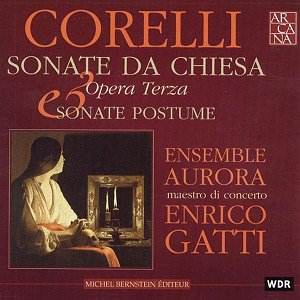
Arcangelo Corelli
Sonate da chiesa, Opera terza; Sonate postume
Ensemble Aurora, Enrico Gatti (violin)
Recorded September 1996 & 1997, Granecy-le-Château church, France
Label: Arcana A 902 [132:15] (2 CDs)
There’s a particular clarity and restraint in Corelli’s music that—despite centuries—still manages to feel fresh, as if you’re eavesdropping on a private conversation in a sunlit Italian chamber. Ensemble Aurora and Enrico Gatti offer us exactly that: not a display of violin fireworks; à la Vivaldi but something more intimate, more considered, almost quietly revolutionary in its understatement. The recording venue—the Granecy-le-Château church—imbues the sound with a warm, natural reverberance rarely captured so well on disc.
One hears the individual string lines soar and blend in tidy counterpoint, textures that remind one, oddly enough, — of a Haydn string quartet’s conversational give-and-take, yet with a baroque self-effacement that defies any attempt at grandiosity. Corelli’s Sonate da chiesa (church sonatas) here leap off the page with their characteristic four-movement design: slow-fast-slow-fast. But it’s the slow movements that fascinate most—their deceptively simple harmonies open space for subtle improvisation, a playground for the solo violin’s expressive nuances.
Take, for example, the slow movement of Sonata Op. 3 II in D major, where Gatti’s bow caresses the phrase endings with a tender hesitancy, as if reluctant to disturb the sacred hush. The ensemble’s approach to the "allegro" movements—especially in Sonata Op.
3 VI in G major—reveals their considerable skill in contrapuntal clarity. The tight rhythmic interplay and clean articulation make one almost forget the music’s age; these are not dusty relics but living dialogue. The bass line, firmly grounded yet never heavy, supports with a subtle pulse that propels without intrusion.
The sheer variety of mood across the discs is remarkable: from the somber, almost plaintive Sonata Op. 3 V in D minor to the radiant la maggiore of Sonata Op. 3 XII.
The latter’s "finale" bursts forth with a cheerful abandon while retaining the elegance and poise characteristic; of Corelli’s style—music that ‘relaxes and soothes,’ yes, but also commands respect for its architectural precision. I must confess, the soundscape here seduces in a way few baroque recordings manage. The strings’ lush warmth is palpable—Gatti’s violin singing with a purity that keeps the ear alert yet comforted.
The occasional trumpet in Sonata WoO 4 adds a curious brightness, a reminder of baroque color palettes that enrich rather than overwhelm. However, perfection is elusive. In a couple of the brisker "allegro"s, the ensemble’s meticulousness borders on stiffness; the music could breathe a touch more, loosen its grip without losing form.
But these moments are fleeting and, if anything, underscore the performers’ respect for Corelli’s idiom—eschewing Romantic exaggeration for baroque poise. Arcana’s presentation deserves praise too. The booklet notes provide a thoughtful, scholarly backdrop that deepens appreciation without veering into dry academicese.
Accessibility and erudition rarely sit so comfortably side-by-side. To sum up: this two-disc set is near-essential for anyone interested in Italian baroque—not just as a historical curiosity but as vibrant, living music. Gatti and Ensemble Aurora give us sonatas that still speak, whisper — and sometimes even sing with a voice that’s unmistakably human.
If you seek virtuosity for its own sake, look elsewhere. But if you want core baroque elegance, textured emotion, and superb musicianship wrapped in a warm sonic embrace, this disc will not disappoint. Corelli’s legacy, measured here with both heart and intellect, shines bright indeed.