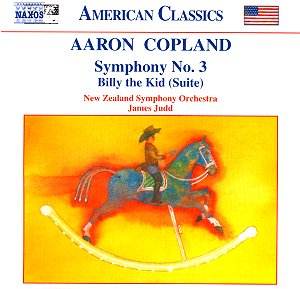
 Aaron Copland
Symphony No. 3 / Suite from Billy the Kid
New Zealand Symphony Company / James Judd
Recorded July 2000, Michael Fowler Centre, Wellington, New Zealand
NAXOS 8.559106 [64:29]
One doesn’t often encounter a recording of Copland’s Symphony No. 3 paired with his Billy the Kid Suite that so effortlessly captures the wide-open spaces of American soundscapes, especially from a Southern Hemisphere orchestra.
The New Zealand Symphony Orchestra, under James Judd’s baton, emerges here as a surprisingly fitting ambassador of this quintessentially American repertory — an ensemble whose string — section, in particular, conveys warmth and clarity, although occasionally it seems to lack just a touch of the heft the score demands in its more brooding moments. Copland’s Symphony No. 3 is a curious beast in his oeuvre: completed in 1946, it firmly; embraces a traditional four-movement structure, a contrast to his earlier, more experimental symphonies.
The opening larghetto unfolds with a spacious lyricism — that characteristic Coplandian “gift to be simple” in full flower. The melodies here are angular yet open, the orchestral texture so transparent it evokes not merely the American landscape but something more abstract — a vastness, yes, but also an innocence steeped in rugged optimism. One can almost sense the dry air, the distant horizon, even if one’s never set foot on the prairie.
This rendition’s pacing is judicious; Judd resists the temptation to rush, allowing the broad phrases to breathe. The first movement’s coda, serene and unforced, lingers with genuine tenderness. Yet, the "scherzo" that follows feels a touch less mischievous than it could be — animated, but without the crackling edge that Bernstein or Mata often bring.
The trio section is a welcome refuge, its calmness a stark contrast to the "scherzo"’s occasional clatter. The slow movement, arguably the symphony’s most challenging for listeners, is handled with care but occasionally risks losing a thread in its complex interplay of motifs. Copland’s music here is not sentimental; it demands attention to subtle shifts in harmony and texture.
The New Zealand players convey this, though sometimes the orchestral fabric feels a little thin, as if the musicians are, understandably, still negotiating the idiom. And then — the "finale". Here, the composer’s borrowing of the famous “Fanfare for the Common Man” theme is both a blessing and a puzzle.
It provides a grand, resonant climax, but why revisit that earlier work so extensively within this symphonic framework remains a question. This release’s rendition is commanding enough, but it lacks the final steel and — well — radiant shimmer one encounters in Bernstein’s or Slatkin’s interpretations. The climaxes swell with conviction, yet the textures aren’t quite as crisply etched, the brass occasionally leaning toward a duller sonority rather than the brilliant, cutting edge the score demands.
Turning to the Billy the Kid Suite, this recording captures much of the ballet’s narrative energy and its evocative evocation of the American frontier. The music’s opening evokes the same open plains as the symphony’s first movement, though here there’s a sharper edge — the lawlessness, the gunfire, the chase. The suite, however, truncates the ballet considerably, omitting some dramatic material near the end.
That said, the New Zealand Symphony handles the folk-derived themes with affectionate authenticity and buoyant rhythm. The lightly scored dances—Mexican Jarabe, Prairie Night Dance—are sprightly and lucid, though at times one misses the gritty textures that a more “American” orchestra might conjure. Judd’s long tenure in Florida seems to have informed his understanding of Copland’s idiom, and he navigates these works with a fastidiousness that never feels forced.
The sound is clean and well balanced, the recording crisp, allowing the listener to appreciate fine orchestral details — the pizzicato in the "finale", the woodwind’s plaintive inflections, the brass’s noble declarations. But, on balance, the orchestra sometimes feels hesitant about fully embracing the brashness and rawness that Copland’s frontier music arguably calls for. A minor quibble: the absence of a detailed synopsis or separate track markers for the Billy the Kid Suite somewhat impedes following the narrative thread, especially for those less familiar with the ballet’s episodic structure.
The leader’s presence feels palpable even in this studio setting.
In sum, this disc is a highly respectable entry into the Copland discography. It may not displace the towering interpretations by Bernstein or Slatkin, but it offers a fresh perspective, particularly given the Kiwi ensemble’s commendable effort to inhabit this music’s distinctly American spirit from halfway around the globe. For those beginning to explore Copland’s mid-century sound world, or collectors seeking affordability without sacrificing integrity, this NAXOS set is a solid recommendation.
It’s a performance of heart and craft, marked by a subtle restraint that, while sometimes correct to a fault, reveals the music’s enduring clarity and optimism. Richard Dyer