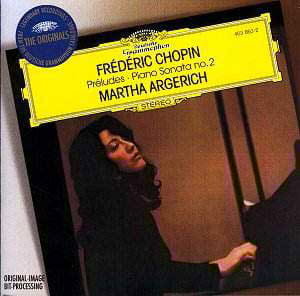
Frédéric Chopin: 24 Preludes op. 28; Prelude in C-sharp minor op. 45; Prelude in A-flat major op.
posth.; Piano Sonata No. 2 in B-flat minor op. 35
Martha Argerich, piano
Recorded 1974 (Sonata), 1975 (Preludes), 1977 (op.
45/posth.)
Deutsche Grammophon Legendary Recordings 463 663-2 [61:17]
Deutsche Grammophon’s “Legendary Recordings” series often prompts a weary sigh—vaults emptied, repackaged, sometimes without much rhyme or reason. Yet here, the label hits the bull’s-eye: Martha Argerich’s Preludes and — well — Sonata No. 2 form a collection worthy of the “legendary” tag.
That word carries weight, and in this instance, it sticks, not from nostalgia alone but from sheer, blazing artistry. Argerich’s Chopin is a paradox — simultaneously feral and precise, tempestuous yet articulate. The 24 Preludes op.
28, recorded in 1975, stand as a testament to this duality. Chopin’s little tonal journeys—each a world unto itself—are often tackled as isolated gems, but Argerich insists they be heard in their entirety, as a cohesive architectural marvel, edges and corners intact. Here, the cycle’s design is vivid: major keys flip to their relative minors, starting in bright C major and curling back home via F major and D minor.
It’s a tonal pilgrimage few pianists delineate with such clarity; the remote keys nestle in the middle, like a sudden detour through shadowed woods before the sunlit clearing. The contrast between preludes is stark. Take nos.
16, 17, and 18—a notorious triad. Many performers, beguiled by the furious fireworks of 16 and 18, risk drowning the tender lyricism of no. 17 beneath bravura.
Argerich, however, walks that tightrope with a rare balance. Her “tigress” mode—hard to shake from these performances—makes the tempestuous preludes roar with unrelenting energy. Yet, when confronted with the elegiac no.
17, she doesn’t soften it into fragility but endows it with a muscular lyricism—call it a “masculine” strength if you must—that allows this interlude to hold its own amid the storm. The result is startling: a cycle that breathes and lives as a single organism, not a patchwork of showpieces. There are moments, though, when the fiery impulse threatens to overwhelm subtlety.
The E minor Prelude (no. 4) erupts into a climax more volcanic than the score invites; one might argue the piece’s inherent restraint is momentarily lost. The “Raindrop” Prelude (no.
15), renowned for its incessant repeated A-flat, usually thrives on a steady, hypnotic pulse. Argerich’s approach here—more fluid, less metronomic—divides opinion but never fails to engage. These are personal quibbles, incidental to the overall teleology of the rendition.
Now, the Sonata No. 2 is a different beast. The famous Funeral March third movement has invited countless interpretations ranging from stoic resignation to morbid obsession.
Argerich’s reading eschews deep existential rumination. Instead, it offers a less brooding, more elemental force—calm but unsparing. Some listeners might find this unsettling, craving a more intimate, reflective approach; nonetheless, the weight of the sonata as a whole remains undeniable.
The "finale", a whirlwind "scherzo" of sorts, is delivered with unfailing velocity and — clarity, her fingers conjuring a texture that sounds impossibly smooth despite its blistering speed. What sets this release apart, then, is not only the technical mastery—though that is prodigious—but the singular personality behind it. Argerich never sacrifices the music’s emotional core to virtuosity; she intensifies it.
The balance of power and poetry achieved here is rare. It’s not flawless, if one insists on purity of style, but it is compelling in the deepest sense. When set against other greats—Pollini, Kissin—her performance seems less a showroom of pianism than a living, breathing entity.
Pollini’s cool brilliance and Kissin’s youthful abandon have their virtues, but neither captures the same wild coherence of Argerich’s vision. In sum: this DG release is indispensable, a touchstone for anyone seeking to understand Chopin’s Preludes and Sonata through the prism of one of the twentieth century’s greatest pianists. Argerich’s performances remain as electrifying today as when first captured on tape.
If you’re already familiar with these works, this disc offers fresh insight; if not, it’s a compelling place to start. A great Chopin disc — with all the imperfections and passions that greatness entails. — John Leeman (with a nod to Richard Dyer)