Carlos Gomes
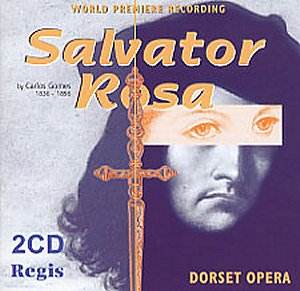
Salvator Rosa (opera, libretto by Antonio Ghislanzoni)
Dorset Opera Band and Chorus, Patrick Shelley (cond.)
Soloists: Lisa Livingston (Isabella, soprano), Fernando del Valle (Salvator Rosa, tenor), Andrea Baker (Gennariello, mezzo), Michael Gluecksmann (Masaniello, baritone), Michail Milanov (Duca d’Arcos, bass), et al. Recorded live, August 11–12, 2000, Sherborne School (Dorset Opera)
REGIS Forum FRC 9201 [2 CDs; 142:07 approx.] ~£12 retail
Few operas emerge from the 19th-century Italianate tradition with the peculiar blend of ambition and — well — unevenness that characterizes Carlos Gomes’s Salvator Rosa. The Brazilian composer—an inhabitant of two worlds, Italian operatic culture on one hand and the patriotic, landscape-infused ethos of his homeland on the other—presents here a curiosity.
Long overshadowed by Il Guarany, his more famous opera, Salvator Rosa had to wait until Dorset Opera’s enterprising summer 2000 staging to receive its first British outing. This release, culled from those performances, is an invaluable document, despite its rough edges and occasional lapses in vocal and ensemble polish. Gomes’s musical language is, unsurprisingly, steeped in Verdian influence—Ghislanzoni’s libretto links him indelibly to Verdi’s world.
The overture opens with gestures uncannily reminiscent of Aida, lush and grand but slightly derivative. And that’s the thing: you sense Gomes trying to carve out a personal voice, yet frequently slipping into tropes and clichés of his models. The duet between Salvator and — well — Masaniello near the opera’s start, for example, threatens to morph into a military march — or “A Life on the Ocean Wave” at any moment—the rhythms are a touch too insistent, the orchestration occasionally bloated.
But within this framework are moments of genuine inspiration. The duets, in particular, glow with tender precision and harmonic inventiveness—Lisa Livingston’s Isabella and Andrea Baker’s Gennariello deliver with radiant clarity, their voices weaving with harp arpeggios that elevate the music from mere pastiche to something almost transcendental. Baker’s “serenade” at the beginning of Act Four is an unexpected highlight, her final B flat ringing with purity and unexpected strength.
Fernando del Valle’s Salvator Rosa, however, is more problematic. His tenor—an intriguing blend of Hungarian and Spanish timbres—is at times thrilling, but too often it strains against the tessitura, with top notes hanging just below pitch and an audible weariness creeping in as the opera progresses. Occasional Mario Lanza-style sobs in the climactic moments rob the role of its gravitas, and the voice’s inconsistency distracts from the character’s complex patriotism and inner turmoil.
The subtle intake of breath before the pianist’s attack.
The male baritone Michael Gluecksmann, cast as Masaniello — tends to bark his way; through agitated passages—a vocal approach that, while forceful, sometimes comes perilously close to caricature. His sustained high notes, such as the Fs and Gs during the acclamation scene, are barely held together, creating an uncomfortable tension rather than thrilling crescendo. Orchestral forces, drawn largely from local professionals and led by former Hallé concertmaster Pan Hon Lee, perform with committed heart.
The Dorset Opera Orchestra’s 42 players navigate Sousa-like marches and verdant Mendelssohnian song without losing; their way, and maestro Patrick Shelley’s fond editorial hand is evident—a loving, if somewhat sentimental, stewardship. The offstage trumpet and chorus in Act Four are atmospheric, though the occasional balance issues (notably with the bassoon in men’s choral sections) surface. The Dorset Opera Chorus, while large and enthusiastic, is uneven.
Some voices pierce through awkwardly, revealing amateurish strain—particularly in the convent scene, where — the electronic organ accompaniment is, frankly, hideous and — well — incongruous, throwing the whole texture off-kilter. The sisters themselves, when breaking into faster rhythms, appear to dash ahead of the beat, undermining any sense of sacred solemnity. One must also mention the absence of biographical notes in the booklet—an unfortunate omission for such an international cast and a composer so deserving of context.
The programme from the live shows, thankfully, fills in gaps: Michail Milanov sings bass (despite the CD box claiming tenor) with imposing authority as the Viceroy, while the rest of the international lineup brings a fascinating if uneven palette of vocal colors to this sprawling work. Salvator Rosa is a patchwork of brilliance and banality, a musical landscape both savage and cultivated, much like the painter it depicts. Like Salvator’s own canvases—wild, stormy, and sometimes enigmatic—the opera fluctuates between breathtaking beauty and moments of pallid artifice.
For the Verdian enthusiast with a taste for rarity, this recording offers a valuable glimpse into a neglected corner of the operatic repertoire. Yet it is not without its caveats: vocal inconsistencies, occasional orchestral roughness, and a libretto that, while dramatic, sometimes veers toward theatrical excess. In the end, Dorset Opera’s recording is a labor of love—imperfect, occasionally flawed, but brave in its pursuit of forgotten repertoire.
For these reasons alone, Salvator Rosa merits attention, study, and, hopefully, a wider hearing. It is a flawed gem, worthy of admiration but not uncritical embrace. If you find yourself near the National Gallery in London, do seek out Salvator Rosa’s self-portrait in Room 32.
The inscription reads, in essence: ‘Shut up unless you have something worthwhile to say.’ Perhaps Gomes’s opera might have done well to heed that advice—yet its music, occasionally radiant, still manages to speak. —Richard Dyer