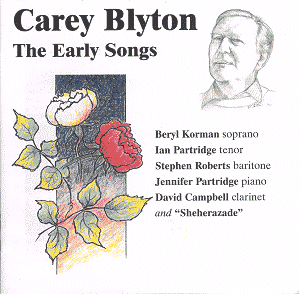
Carey Blyton: The Early Songs Beryl Korman (soprano), Ian Partridge (tenor), Stephen Roberts (piano), Jennifer Partridge (piano), David Campbell (clarinet) Scheherazade Ensemble: Verona Chard (soprano), Denise Dance (flute), Fiona Clifton-Welker (harp) Recorded — November 2000, Snape Maltings, Suffolk Label: Upbeat URCD 160 [79:23] — Carey Blyton’s The Early Songs is, at first blush, a curious anthology—not quite an early-career retrospective, nor exactly a neat thematic collection. The somewhat misleading title hints at a jumble of periods, a sprinkling of youthful compositions alongside more mature miniatures, and, intriguingly, a scattering of settings that betray a restless and distinctive musical personality. This is not a composer content to linger in one style or genre; rather, Blyton’s musical imagination is a kaleidoscope—sometimes witty, sometimes tender, often idiosyncratic.
The disc opens with the Three a.m. songs, Op. 9, dating from 1951, when Blyton was barely out of his teens and — well — still convalescing from polio. Knowing this, one listens with a heightened sensitivity to the tension beneath their apparently effortless surface.
There’s a kind of sly urbanity here—hints of seedy sophistication and a languorous melancholy—that feels uncomfortably modern for such youthful works. Blyton’s harmonic language is economical yet expressive; his piano writing, compact and sometimes brusque, frames the vocal lines with a slight edge of unease. The singing of Beryl Korman is, for the most part, poised and limpid, though occasionally the very; top notes press a bit too hard, but her diction is impeccable and thoughtful—she makes every word count.
Then comes Op. 10, Two Pensive Songs, where Blyton’s own poetry sits alongside that of Donald Hills. The music here conceals a darker undercurrent beneath its polished veneer—the voices here seem to murmur secrets just out of earshot.
The interplay between the voice and piano, especially in “Come Night,” is delicately shaded: subtle — shifts in rhythm and unexpected harmonic turns draw the listener deep into a shadowy interior landscape. Stephen Roberts, who also handles the piano in the French-language Toi et Moi cycle, makes a very fine impression—his touch is sure, his tone generous, and he navigates Blyton’s shifting meters and harmonic nuances with commendable poise. Ah, Toi et Moi, Op.
11—five settings from Paul Géraldy’s poems. Blyton’s choice here is bold. Not many English composers of the time tackled French texts with such confidence, let alone at age twenty.
There’s a certain Poulencian charm—playful yet sophisticated—that pervades the cycle, particularly in the third movement, “Post scriptum,” where a jaunty, coquettish piano line dances around the tenor’s fluttering phrases. Blyton’s gift for melody shines here; it is clear no note is wasted, and the economy of his musical language belies the depth of feeling beneath. A pity that the booklet omits translations—listeners unfamiliar with Géraldy’s words will miss some of the pointed wit and — well — nuance in the word-painting.
The instrumental colour shines in Moresques, Op. 14, scored for soprano, flute, harp, and piano. Here, Blyton’s sensitivity to timbre is remarkable—especially in the harp writing, which is idiomatic, fluid without ever sounding indulgent or clichéd.
The Scheherazade ensemble’s rendition is a highlight: Verona Chard’s soprano is clear and expressive, Denise — Dance’s flute breathes with supple lyricism, and Fiona Clifton-Welker’s harp is a shimmering presence throughout. One wonders who might have guided Blyton’s early harp writing—there is a fluency here that suggests close collaboration with a harpist. The Spanish-inflected poetry of David Munro fits naturally with this sonic tapestry, evoking a sun-drenched, slightly exotic sound world.
Interspersed among these cycles are several other gems—Prayers from the Ark (Op. 48), a charming collection of animal poems by Carmen Bernos de Gasztold, stands out for its wit and restrained humour. Each piece ends with an affirming “Amen,” lending a ritualistic feel that contrasts wittily with the playful character of the texts.
From the ox’s two-note drone to the lark’s soaring top F, Blyton’s musical characterisation is deft and imaginative. Jane Manning premiered these in 1974, and it’s easy to imagine her clear diction and keen dramatic sense bringing these small vignettes to life. The disc’s inclusion of later works such as The Flea (1992) and Indigo Blues (1999) adds an intriguing coda to this collection.
The Flea is unexpected in its gravitas—a setting of “Adam ad ’em” with a Beethovenian storm raging in the piano introduction before the vocal line enters with ironic detachment. This is Blyton showing a darker, more profound side; the contrast with the earlier cycles couldn’t be starker. Indigo Blues carries a political edge, its colonial overtones biting beneath a deceptively jaunty melody.
Together, these later pieces remind us that Blyton’s voice was never static. Ian and Jennifer Partridge’s contributions should not be overlooked. Ian’s tenor — which I first admired in early music circles, here luxuriates in Blyton’s melodic lines with a freshness that suggests genuine delight.
Jennifer’s piano work, especially in the more intricate accompaniments, is polished and sensitive. In combination with Stephen Roberts, the pianists provide a flexible and nuanced foundation that supports the singers without ever overwhelming them. A minor quibble: the booklet notes are uneven, with some lapses in clarity and, oddly, the curious disappearance of Mary Q.
Palimpsest—her departure leaves a rather prosaic voice to guide listeners, undermining what might have been a richer contextualisation. In sum, The Early Songs reveals Carey Blyton not just as a minor figure with a quirky catalogue, but as a composer of genuine craft and — well — subtlety. His music balances accessibility with sophistication; it is marked by a keen ear; for text setting, a fluent melodic gift, and a judicious use of instrumental colour.
This collection is an essential corrective to Blyton’s reputation as merely a purveyor of light music or children’s tunes, proving that beneath the surface lies a serious, thoughtful artist. Not perfect—no disc ever is—but richly rewarding. An invitation to revisit, to listen again and listen closer.
Blyton’s voice deserves no less.