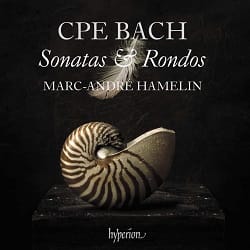
Carl Philipp Emanuel Bach: Sonatas and Rondos
Marc-André Hamelin, piano
Hyperion CDA68381/2 (2 CDs: 137 minutes)
Recorded in Mechanics Hall, Worcester, Massachusetts, 2021
The second Bach son—the one who mattered most to Mozart and Haydn, who transformed keyboard style from his father’s polyphonic universe into something restless, unpredictable, shot through with theatrical gesture—has never wanted for champions. But he’s rarely had one quite like this. Marc-André Hamelin brings his formidable technical arsenal to bear on two discs of C.P.E.
Bach’s keyboard music, and the results are… well, they’re both revelatory and slightly disconcerting. This is playing of such startling clarity, such diamond-hard precision, that you hear these pieces—many of them familiar from harpsichord recordings—as if for the first time.
The question that hovers over the enterprise: is this what we should be hearing? Hamelin has chosen the modern piano, which immediately sets him apart from the period-instrument orthodoxy that has dominated this repertoire for decades. More than that: he’s chosen to really play the piano, exploiting its dynamic range,; its sustaining power, its capacity for gradation that the harpsichord and fortepiano simply don’t possess.
In the Sonata in F minor, Wq 57/6, those sudden sforzandi hit like; thunderclaps—C.P.E.’s famous Empfindsamkeit rendered not as polite sentiment but as genuine emotional violence. The technical challenges here are considerable, and Hamelin dispatches them with his customary sangfroid. The rapid repeated notes in the "Rondo" in E major, Wq 57/1, emerge with crystalline evenness.
The wide leaps, the hand-crossing passages, the abrupt changes of register that C.P.E. loved—all negotiated with an ease that makes you forget they’re difficulties at all. In “Farewell to my Silbermann Clavier,” Wq 66—a piece of genuine poignancy, written when the composer had to part with his beloved instrument—Hamelin finds a singing tone that belies the piano’s percussive nature.
But does all this virtuosity serve the music? I found myself wrestling with this throughout. The Sonata in A major, Wq 55/4, benefits enormously from the piano’s capacity to shape long melodic lines, to create genuine cantabile.
Those slow movements—and C.P.E.’s slow movements are often his most radical inventions—gain a depth of expression that can elude period instruments. The central Poco "adagio" of the F-sharp minor Sonata, Wq 52/4, becomes a kind of proto-Romantic soliloquy, harmonically daring even by today’s standards. Yet there are moments when I missed the harpsichord’s bite, its percussive attack.
C.P.E. Bach’s music is full of surprises, sudden jolts, rhetorical gestures that depend on sharp articulation. The piano’s very beauty can soften edges that perhaps shouldn’t be softened.
In the "Rondo" in C minor, Wq 59/4, Hamelin’s elegant pianism occasionally makes me long for the harpsichord’s capacity to spit and snarl. The programming across these two discs is intelligent—a mix of well-known pieces and comparative rarities, drawn from different periods of C.P.E.’s long career. We get the Prussian and Württemberg sonatas alongside later works that show the composer’s style growing ever more eccentric, more personal.
The Sonata in G minor, Wq 65/17, from 1781, sounds almost like Haydn having a nervous breakdown—which is meant as a compliment. Hyperion’s engineering captures Hamelin’s sound with characteristic fidelity. The acoustic of Mechanics Hall in Worcester provides enough resonance to warm the tone without blurring detail.
You can hear the action of the piano, the release of dampers, the physical reality of interpretation—details that matter in this repertoire where gesture and rhetoric are everything. I keep returning to the question of authenticity, that vexed and probably meaningless term…. C.P.E.
Bach himself was a pragmatist about instruments; he wrote for clavichord, harpsichord, and — well — early piano, adapting his style to each. Would he have objected to Hamelin’s approach? Probably not.
Would he have been astonished by the instrument’s capabilities? Certainly. Does that settle the matter?
Not quite. What Hamelin offers is an alternative vision, persuasively argued through sound. This isn’t historically informed performance in the conventional sense—it’s musically informed performance, brought to life by an artist who understands that these pieces are more than documents of a transitional period.
They’re living music, strange and wonderful, full of ideas that still startle. The playing itself is beyond reproach. Hamelin’s virtuosity never calls attention to itself; it’s always in service of musical ends.
His sense of timing, of when to push forward and when to hold back, feels instinctive. The ornaments are executed with clarity and purpose, not as mere decoration but as essential components of the musical argument. This is a major achievement—two discs that will certainly provoke argument among the period-instrument faithful but which make an undeniable case for C.P.E.
Bach as a composer whose music can sustain, even demand, multiple interpretive approaches. Hamelin has given us not the last word but a compelling new chapter in our ongoing conversation with this endlessly fascinating composer. I’ll be returning to these performances often, even as I continue to cherish my Leonhardt and van Asperen recordings.
There’s room for all of them.