Anton Bruckner (1824–1896)
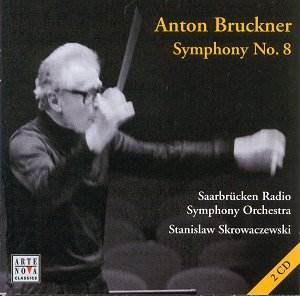
Symphony No. 8 Saarbrücken Radio Symphony Ensemble / Stanislaw Skrowaczewski Recorded Kongresshalle, Saarbrücken, 8–9 October 1993 Arte Nova 74321; 34016 2 (2 CDs) [82:24] There’s a certain gravitas that clings to any performance of Bruckner’s Symphony No. 8, and Skrowaczewski’s 1993 Saarbrücken recording is no exception—though it arrives with a modest price tag that belies the serious artistry on offer.
A rare bargain in the often overpriced Bruckner discography, this account quietly stakes its claim among the more thoughtful, if less flamboyant, interpretations. At just over eighty-two minutes, the pacing here is deliberately unhurried. Not sluggish, mind you, but paced with a breadth that demands patience.
This is no racing through the thematic development; rather, Skrowaczewski lets the architecture of the symphony breathe and expand in a way that rewards close listening. The "Adagio", for example, unveils its veiled string textures with a subtlety that’s almost tactile—listen at 5’12” for — the refined emergence of those muted violins, barely sounding but palpably present, as if caught in a half-light. It’s a reminder that Bruckner’s darkness often lies not in sheer volume but in the layering of tone colours and micro-dynamics.
The Saarbrücken players respond with commendable clarity and robustness. Their sound is robust, yes, but never coarse or bludgeoning. I dare say, there are moments when a touch more individual flavour from the solos—particularly in the woodwinds—would have added welcome colour.
Yet, the ensemble’s collective discipline under Skrowaczewski’s baton shines through, especially in the climaxes, which build with a natural swell rather than a forced crescendo. The conductor’s affinity with Bruckner’s phrasing is evident: he punctuates the long melodic paragraphs with a sure hand, giving the symphony a coherent narrative arc instead of the often meandering feel these sprawling movements can succumb to. The "finale" spills onto the second disc—a structural necessity, perhaps, but it also mirrors the unfolding drama of the music itself.
Here, Skrowaczewski navigates the immense architectural challenges with a keen sense of proportion. The tension between the monumental and the intimate is finely balanced; one never feels overwhelmed by the sheer mass of sound. His control over dynamics, particularly at the end of the "Adagio" — reveals a leader who understands that the power of Bruckner’s music lies in its gradations—a subtle decrescendo or a barely perceptible diminuendo can communicate as much as a fortissimo blast.
You can almost hear the rosin dust settling on the strings.
What this production lacks in the idiosyncratic grandeur of a Karajan or the archaic mysticism of Knappertsbusch, it makes up in thoughtful construction and textual clarity. It’s a big, dark-textured performance—yes—but one that listens as much as it speaks. The recording quality — too, merits mention: the acoustic of the Kongresshalle is neither overly reverberant; nor brittle, lending a natural resonance that captures the orchestra’s nuances without smearing the detail.
To sum up: if you already own the giants of the Bruckner 8 discography, this Skrowaczewski is unlikely to topple them from your pedestal. Yet it offers a compelling alternative, one that rewards slow immersion and repeated hearings. It’s a execution of substance and subtlety, not spectacle—and at this price, a very welcome addition to any serious Bruckner collection.