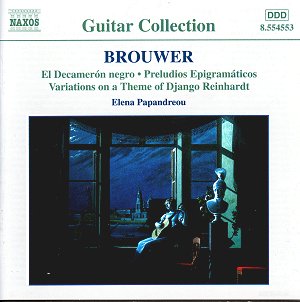
Leo Brouwer: Guitar Music, volume 2
Elena Papandreou, guitar.
Naxos 8.554553. Compact disc, 73:13.
Leo Brouwer occupies an odd position in the guitar world—revered by players, respected by composers, yet somehow remaining just outside the general consciousness of even committed concertgoers. This second Naxos volume helps explain both the reverence and the distance.
The program draws from what might be called Brouwer’s experimental middle period, when he was pushing hard against the instrument’s Romantic inheritance. “Canticum” (1968) demands a detuned sixth string—E-flat instead of E—which gives the whole piece a peculiar, unsettled quality, like hearing familiar speech with a slight accent you can’t quite place. The work allegedly depicts an insect emerging from its chrysalis, and while I’m generally skeptical of such programmatic conceits, there’s something genuinely metamorphic in the writing, especially in Papandreou’s handling of the fragmented gestures that coalesce into longer melodic lines.
“La espiral eterna” supposedly takes inspiration from DNA’s double helix. Well. Whether Brouwer was thinking about Watson and Crick or simply constructing interlocking musical strands doesn’t much matter—what comes through is a restless, spiraling energy that the Greek guitarist manages with admirable clarity. She never lets the architecture collapse into mere effect.
The real discovery here, at least for me, is the six Preludios epigramáticos from 1981. Brief, aphoristic, they compress Brouwer’s harmonic language into miniatures that recall—without imitating—Villa-Lobos’s preludes. Papandreou understands their epigrammatic nature; she doesn’t inflate them or sentimentalize. Each one breathes and ends, complete.
El Decamerón negro, the three-movement suite from 1981, represents Brouwer in what he called his “national Hyper-Romanticism” phase—a term that sounds more pretentious than the music actually is. Written for Sharon Isbin and based on African folk tales collected by Leo Frobenius, it explores Afro-Cuban traditions with considerable sophistication. “El arpa del guerrero” opens with those distinctive percussive attacks on the soundboard that have become something of a Brouwer signature. Papandreou produces them cleanly, without exaggeration—they punctuate rather than dominate. “La huida de los amantes sobre el valle de ecos” is the most overtly romantic movement, and here I wish she’d allowed herself slightly more timbral variety. The echoes feel a bit monochromatic. But “Ballada de la doncella enamorada” receives an interpretation of real tenderness, the melodic line singing without strain.
The Variations on a Theme of Django Reinhardt take Reinhardt’s “Nuages” as their starting point—apparently the only time Brouwer has used theme-and-variation form, which seems curious for a composer of his generation and inclinations. The variations move from jazz-inflected harmonies through more abstract territories, though never entirely abandoning the theme’s wistful character. Papandreou navigates the stylistic shifts with intelligence, if not always with the kind of improvisatory freedom the material might invite.
Technical demands throughout this repertoire are considerable. Brouwer asks for sounds that lie outside the guitar’s conventional palette—those detuned strings, percussive effects, extreme dynamic contrasts in rapid succession. Papandreou handles them with what I can only call unflappable competence. Her tone remains focused even in the most awkward passages, her rhythm secure even when the meter fragments.
But—and this matters—competence isn’t quite the same as revelation. Her previous Naxos disc (Stravinsky, Dyens, Koshkin) showed similar qualities: scrupulous preparation, intelligent musicianship, technical solidity. What’s sometimes missing is that extra dimension of personal urgency, the sense that this music must be played exactly this way and no other. In “Tarantos,” for instance, the flamenco elements feel more referenced than inhabited. She plays the notes correctly, observes the rhythmic inflections, but something of the music’s raw nerve remains just out of reach.
The recording, made in what sounds like a relatively dry acoustic, serves the music well enough. Close but not claustrophobic. You hear the left-hand slides, the breath of the right-hand attack, the subtle buzz of a string against a fret—all the intimate details of guitar playing captured without fetishizing them.
For Brouwer enthusiasts, this disc is essential—no question. It documents a crucial phase of his development and includes pieces (those preludes especially) that deserve wider currency. Papandreou’s performances are more than respectable; they’re often genuinely illuminating. Whether they’re definitive is another matter. But in this repertoire, at this price, with this level of musical intelligence, one shouldn’t complain too loudly about the absence of miracles.
The guitar repertoire remains stubbornly resistant to canonization, and Brouwer’s more experimental works will likely remain specialists’ territory. This disc makes the best possible case for them—which is to say, it plays them straight, trusts their musical substance, and lets them speak. Sometimes that’s enough.