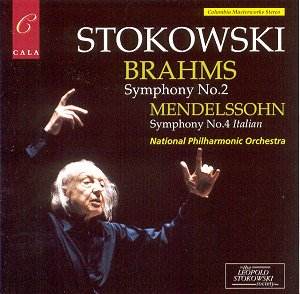
Johannes Brahms, Symphony No. 2 in D, Op. 73; Felix Mendelssohn, Symphony No.
4 in A, Op. 90, Italian
National Philharmonic Band (1972)
Conductor: Leopold Stokowski
Recorded: EMI Studio One, Abbey Road, London, April & June 1977
Label: Cala CACD0531 (originally Columbia Masterworks)
Duration: 73:43
Release: First CD edition from original analog tapes, restored by Cala in association with the Leopold Stokowski Society
When one thinks of Leopold Stokowski at ninety-five, there’s an immediate temptation to imagine a faded shadow of the flamboyant impresario famed for his colorful orchestral dressings and occasionally indulgent interpretations. Yet these recordings of Brahms’s Symphony No.
2 and Mendelssohn’s Italian Symphony – originally cut in the mid-1970s and now resuscitated by Cala Records – decisively disabuse us of that notion. Instead, what emerges is a vivid, living thing—a testament to Stokowski’s undiminished command, his still nimble baton, and the National Philharmonic’s responsive ensemble. This is music-making shot through with vitality, not some dusty relic of past glories.
To begin with the Italian Symphony, its opening "allegro" vivace is a model of ebullience yet tempered finesse. The pulses bounce along buoyantly without succumbing to the headlong rush that so often afflicts this movement. Stokowski avoids the trap of excessive "presto", instead coaxing a rhythmic buoyancy that lets; Mendelssohn’s sparkling woodwinds sing with crystalline clarity against a lush but never heavy string backdrop.
The near-perfect balance here—the woodwind filigree skimming delicately above the strings—is a small miracle — of orchestral sonority, and the recording’s clean, warm acoustic captures every nuance with enviable transparency. The "andante" con moto second movement moves with a graceful forward momentum that eludes sentimental languor. There’s life in those phrases—more than mere surface prettiness—and the orchestra breathes organically, not forced or artificially sweetened.
The director’s presence feels palpable even in this studio setting.
By the "scherzo", the texture lightens further; here, the music almost dances, unencumbered by the weight of Mendelssohn’s more ambitious structures. The "finale", often mishandled by conductors eager to impress with breakneck speeds, is given a more judicious "presto". The effect: each of Mendelssohn’s subtle ornamental details is laid bare, allowing the music’s inherent vivacity to emerge without haste or blurring.
Turning to Brahms’s Symphony No. 2, the opening movement’s first repeat is observed—a detail no Brahmsian purist can overlook. But beyond mere structural fidelity — what strikes most is the organic growth Stokowski instills in the movement.
His pacing is generous yet never indulgent, a steady unfolding that manages to convey Brahms’s unfolding drama without theatrical excess. The orchestral texture is warm, the phrasing long-breathed and Beecham-like in its seamless legato, encouraging; the music to sing as a cohesive whole rather than a collection of disconnected motifs. The "andante"’s lyricism is heartfelt, with a palpable sense of melancholy that never lapses into mawkishness.
Stokowski’s reading reveals the movement’s underlying tension without sacrificing its pastoral serenity. The allegretto third movement is notable for its clear articulation of structural paragraphs—particularly the penultimate moment before the reprise, where the music pauses almost rhetorically, signaling a subtle but effective change in mood. The "finale" drives forward with inexorable energy, but notably without the rushed feel of many modern performances—the excitement grows from within the music itself, not from the conductor’s accelerando.
Throughout, the National Philharmonic Orchestra proves itself an ideal medium for Stokowski’s vision: precise, lyrical, and imbued with a freshness that belies the studio setting. The production, while not dazzlingly spectacular in sonic terms, delivers clarity and warmth—preserving the nuances of the performances with commendable fidelity. This is no mere archival curiosity but a vital reintroduction to a late-career Stokowski who respected the score and championed vitality over mannerism.
These performances may not unseat the likes of Abbado, Barbirolli, or Karajan from their Brahms pedestals, but they provide a compelling and wholly credible alternative viewpoint—one that complements rather than competes. The Italian Symphony here is similarly a rare delight, a synthesis of sparkle, elegance, and judicious pacing that avoids the pitfalls of superficial brilliance or leaden weight. A fascinating glimpse of a great conductor in his twilight years, this disc deserves a place on listeners’ shelves—not just for curiosity’s sake but for the sheer musical joy it imparts.
Cala’s release is warmly to be welcomed, and one hopes it presages more from the Stokowski Society vaults. In sum: vigorous, thoughtful, and thoroughly idiomatic. A minor miracle, surely.