Johannes Brahms (1833–1897)
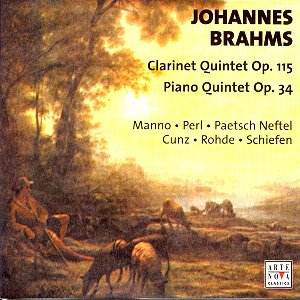
Clarinet Quintet in B minor, Op. 115
Piano Quintet in F minor — Op. 34
Ralph Manno (clarinet) — Alfredo Perl (piano)
Michaela Paetsch Neftel, Rahel Cunz (violins), Hartmut Rohde (viola), Guido Schiefen (cello)
Recorded 14–15 August 1995, Iglesia San Francisco de Telde, Las Palmas de Gran Canaria
ARTE NOVA 74321 30493 2 [74:24]
Two Brahms quintets, both towering pillars of chamber music, offered here not with glossy perfection but with a sincerity that invites close attention.
The Clarinet Quintet in B minor, Op. 115—Brahms’s autumnal farewell to the clarinet—lingers in the atmosphere like a slowly dimming sunset. The Piano Quintet in F minor, Op.
34, by contrast, pulses with Brahms’s characteristic storm and intensity, a work of raw emotional force and architectural mastery. Ralph Manno’s clarinet tone is immediately arresting—at once warm and incisive, with a velvety edge that never blunts the instrument’s inherent lyricism. There’s a subtle tension in his phrasing, a kind of expressive hesitation that fits perfectly with Brahms’s late-romantic idiom.
The opening movement of the quintet unfolds with a measured gravity; the tempo is unhurried but neither sluggish nor sentimental. Manno’s breath control impresses, especially noticeable in the extended legato passages where the clarinet seems to sing without interruption, as if the phrase were endless. Alfredo Perl’s piano playing is an essential counterpoint throughout both works.
His touch is subtle yet unyielding, a rare combination in this repertoire where the piano can easily dominate or retreat timidly. Particularly in the Piano Quintet, his dynamic shadings carve out an intimate sound world that at times suggests a whispered conversation, at others, a forceful declaration. The opening of the first movement bristles with a volatile energy—Perl’s attack is crisp but never harsh, and his pedal work colors the harmonies with haunting resonance.
The strings — as a collective unit, deserve credit for their nuanced ensemble work. Paetsch Neftel and Cunz’s violins are agile and expressive, neither overshadowing the clarinet nor the piano but weaving their lines into a seamless texture. Hartmut Rohde’s viola brings a warm, dusky hue, and Guido Schiefen’s cello anchors the proceedings with a rich, resonant bass.
The subtle intake of breath before the pianist’s attack.
One senses a chamber group finely attuned to Brahms’s often complex interplay of voices—a group that listens as much as it plays. What strikes me most about these performances is their atmospheric coherence. The recording venue—an ancient church in Gran Canaria—imbues the sound with a natural reverberation that somehow suits Brahms’s late style, lending a kind of spiritual spaciousness without sacrificing clarity.
It’s a rare balance to achieve, and here it underscores the works’ introspective qualities without turning them into mere exercises in nostalgia. The Clarinet Quintet glows with that quintessential Brahmsian autumnal warmth—rich — reflective, tinged with melancholy. Tempi are well-chosen, allowing the music to breathe, especially in the slow movement where time seems to dilate and every graceful melodic turn is savored.
There’s a quiet dignity in the "finale"—not the fiery fireworks one might expect but a gentle winding down, as if Brahms himself were bidding farewell to a dear friend. Turning to the Piano Quintet, the mood shifts to a more tempestuous realm. The opening movement’s driving rhythms and impassioned themes are rendered with admirable energy; yet, Perl’s sensitive, ever-attuned pianism ensures the music never feels forced or overwrought.
The "scherzo" twinkles with mischievous vitality, balanced against the dense, brooding slow movement; where the strings’ sultry harmonies and — well — Perl’s nuanced shading create a palpable tension. There are moments when ensemble balance teeters—such is the risk in any chamber work with piano—but these are fleeting and — well — forgiveable. One might crave a touch more bite in the string articulation or a slightly more incisive attack in the piano’s fortissimo passages.
Still, these minor quibbles do not detract from the overall impression of a deeply felt, musically intelligent reading. In a discography brimming with stellar interpretations of these two quintets, this Arte Nova release — stands out chiefly for its atmospheric richness and the genuine musical rapport among this international cast. It may not reinvent the wheel, but it reminds us why Brahms’s chamber music remains endlessly absorbing: his capacity to combine architectural grandeur with human vulnerability, to summon both storm and — well — caress within a few bars.
For those seeking an interpretation that balances passion with understatement, and — well — warmth with incisiveness, this set warrants serious attention—especially at its very attractive price point. It’s a reminder that Brahms’s chamber works, while demanding, reward the listener with profound emotional depth and formal brilliance. In short: a quietly compelling journey into two of Brahms’s most personal masterpieces, brought to life here with a mixture of ardor and poise that respects the music’s timeless complexity.
Not the definitive account, perhaps—but an honest and richly rewarding one.