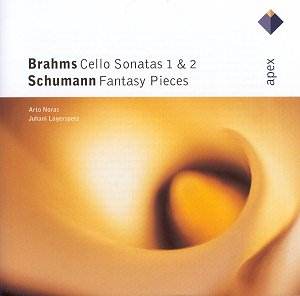
Brahms: Cello Sonatas nos. 1 and 2. Schumann: Fantasiestücke, op. 73
Arto Noras, cello; Juhani Lagerspetz, piano.
Apex 09274 05982. Originally released on Finlandia, 1996. Recorded at Järvenpää Hall. Compact disc, 66:16.
Arto Noras belongs to that generation of Finnish cellists—think of Erkki Rautio—who absorbed the great Central European tradition without losing a certain Nordic clarity of utterance. His tone has heft without mushiness, and his phrasing breathes naturally, as if he’d lived with this music so long he no longer needs to think about where the phrases go. Which is, of course, exactly what we want.
The E Minor Sonata opens with that peculiar Brahmsian mixture of reserve and urgency—the melody arching upward as if testing the limits of its own reticence. Noras gives us the full warmth of the line without wallowing, and his sense of the long paragraph is admirable. But here’s where things get interesting: Juhani Lagerspetz, an accomplished player in his own right, seems content to remain slightly in the shadows. The engineering doesn’t help—the cello sits a bit forward in the Järvenpää Hall acoustic, pleasant as that space generally is—but there’s also a question of temperament. Brahms conceived these works as genuine duos, the piano part as elaborate and demanding as anything in the chamber literature, yet Lagerspetz seems to be accompanying rather than partnering.
Take the opening of the F Major, op. 99, where the piano should burst in with those agitated triplets, setting the emotional temperature for everything that follows. Lagerspetz plays them accurately, even sensitively, but without quite the animal energy the music craves. The "Allegro" vivace marking isn’t just about speed—it’s about a quality of nervous intensity, that restless Brahmsian spirit that can’t quite settle. Noras, to his credit, tries to compensate with extra vehemence in his own line, and the result is effective enough, though the balance tilts.
The slow movements tell a different story. In the "Adagio" affettuoso of op. 99, both players find common ground in music that seems to suspend time itself—those long-breathed melodies that Brahms spun out with such apparent effortlessness (the manuscripts tell another story). Here the slightly recessed piano sound becomes almost an advantage, creating a halo effect around the cello’s sustained cantilena. Noras’s vibrato, always well controlled, achieves a particularly poignant quality in the movement’s central section, where the harmonies darken and the music seems to look inward.
The question of tempo in op. 38’s opening—marked "Allegro" non troppo—has always been vexed. Too slow and the music sags; too fast and it loses its brooding quality. Noras opts for a genuinely relaxed pace, which makes Brahms’s decision to omit a proper slow movement seem all the more logical. The Allegretto quasi "menuetto" that follows provides enough contrast without requiring a drastic gear shift. I’m less convinced by the "finale", where the fugal writing needs more bite—more Bachian severity—than either player provides. They’re both too nice about it.
Schumann’s Fantasiestücke make an apt coupling, though calling them that seems almost insulting to pieces of such concentrated beauty. Written in 1849 for clarinet and piano (with violin or cello as alternatives), they capture Schumann in one of his more stable creative periods, before the darkness descended for good. The “Zart und mit Ausdruck” of the opening piece receives a genuinely tender reading—this is chamber music-making of real intimacy, even if it doesn’t quite erase memories of Rostropovich’s more impassioned approach with Britten at the keyboard.
The recorded sound throughout is clean and well balanced within its chosen perspective, though I wish the producers had pulled the cello back just a hair. The Apex reissue—this was originally a Finlandia disc from 1996—offers distinguished value, and Noras’s artistry is never in question. But the Brahms sonatas demand more than accomplished playing. They need two strong personalities in genuine dialogue, each willing to challenge the other, to push back when the music demands it.
What we have here is very good Brahms playing—musical, intelligent, often moving. What we don’t quite have is great Brahms playing, the kind that makes you forget you’re listening to a recording at all. For that, you’d still want to hear Fournier and Firkušný in op. 99, or Starker with Buchbinder. Still, at bargain price, this disc offers much to admire, and Noras remains a cellist worth hearing in almost anything.