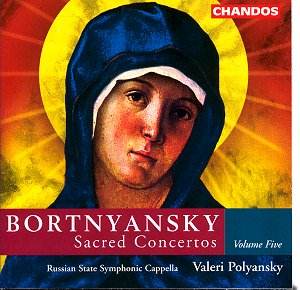
Dmitri Stepanovich Bortnyansky (1751–1825)
Sacred Concertos, Volume 5: Nos. 30–35 Russian State Symphonic Cappella / Valeri Polyansky Recorded 1989/90 in Dormition Cathedral, Smolensk, and St Sophia’s Cathedral, Polotsk Chandos CHAN9956 [DDD] 60:33 There’s something almost conspiratorial; about unearthing a recording that’s been shelved for over a decade—like stumbling on a manuscript in a dusty archive, its pages yellowed but its music still vivid. Chandos deserves applause, then, for finally releasing this concluding volume of Bortnyansky’s Sacred Concertos.
In an industry obsessed with recycling shibboleths, their focus on this somewhat neglected repertoire feels both brave and necessary. Bortnyansky’s music—straddling the ecclesiastical and the operatic—is often a study in contrasts. He isn’t the Russian church composer one might immediately call to mind: his sacred works are suffused with Italianate lyricism, a residue of his Roman sojourn under the tutelage of Padre Martini and — well — others.
One hears in these concertos that melding of styles—sometimes a choral phrase will suddenly bloom into something almost theatrical, recalling the bel canto grace of 18th-century opera seria. Tchaikovsky, notably, edited these works and — well — remarked on their operatic flair—no idle observation. Take the opening of No.
30, “Hear my voice, O God.” It’s the disc’s longest movement and quite simply a marvel of expressive line. The choir’s phrasing here breathes and sighs with a near-human vulnerability, supported by a delicately scored orchestral fabric that never overwhelms. The Russian State Symphonic Cappella’s blend is impeccable, their tuning pin-sharp even in the exposed high passages.
There’s a crystalline quality to the soprano line—almost fragile yet unwavering—underscoring the prayer’s intimate character. Contrast this with the celebratory "finale" of No. 31, “For God is the King of all the Earth,” where the texture expands dramatically.
Here, Bortnyansky’s skill in managing dynamics—swelling from hushed reverence to robust exultation—is masterful. The choir and ensemble respond with impressive agility; Polyansky’s tempi, neither rushed nor languid, keep the momentum taut without sacrificing nuance. The acoustic of the cathedral recording adds a reverberant halo, though occasionally this cathedral largeness threatens to blur the finer textual details.
Still, the balance leans towards clarity, a testament to the engineering. No. 33’s third movement, “Yea, as I walk through the valley of the shadow of death,” is a study in restraint.
The choir’s softer dynamics here are a lesson in control—no vibrato excess, just pure tone hovering over a sparse continuo. It’s a moment of profound lyricism that somehow manages to hint at darkness without succumbing to melodrama. Polyansky’s direction reveals a deep understanding of the text’s emotional and theological weight, making this a genuinely moving experience.
Equally compelling is the opening of No. 35, “Lord, who shall abide in thy tabernacle?” The texture here is astonishingly light—almost transparent at times—with the sopranos floating above a subtly shifting harmonic bed. The interplay between voices and strings glimmers with intimacy and precision.
This movement feels like a whispered secret in the vast cathedral space; the choir’s breathing and articulation are so finely tuned that you can almost make out individual consonants and syllables. The penultimate movement, “But let the righteous be glad” from No. 34, presents a particular challenge: the choir’s high tessitura is notoriously exposed, and yet the Russian State Symphonic Cappella navigates it with enviable ease.
There’s a slight edge of steel in the sopranos’ upper register that cuts through the orchestration without harshness—proof of both technical prowess and judicious rehearsal. On the whole, the album’s engineering successfully captures the reverberant acoustics of Smolensk and Polotsk cathedrals. The natural decay of sound, the subtle echoes from vaulted ceilings, lend an authenticity that studio dryness simply cannot match.
Yet there are moments—brief though they are—when the spatial envelopment risks smudging the intricate polyphony. This is a perennial trade-off in sacred music recorded on location, but here it’s managed with considerable skill. Polyansky’s baton never wavers in these performances.
His pacing is judicious—never artificially elongating phrases but allowing ample space for reflection. The choir’s responsiveness to his cues is palpable: they swell and recede, articulate and sustain with a near-telepathic unity. In pieces where text setting is paramount, this unity is essential, and here it’s achieved with consummate artistry.
To be frank, Bortnyansky’s Sacred Concertos are not in the same league of; profound innovation as, say, Rachmaninoff’s liturgical choral works or even Tchaikovsky’s sacred music. Yet there is in them a distinct appeal—an elegance, a sincere spirituality wrapped in melodic charm and deft counterpoint—that rewards patient listening. This final volume confirms the series’ value, not just as a rediscovery but as a vital corrective to the standard choral repertoire canon.
Chandos’ release of this fifth volume is, therefore, not mere archival filler but a; vital contribution to the understanding of Russian sacred music’s rich, if sometimes overlooked, heritage. For all its occasional acoustic softness and the inherent stylistic tensions of Bortnyansky’s idiom, the disc offers a vivid, deeply human encounter with music that is as much prayer as interpretation. In sum: essential for connoisseurs of choral music, curious scholars of Russian liturgical traditions, and anyone open to the shimmering crossroads where East meets West in the late 18th and early 19th centuries.
This is earnest, eloquent music, lovingly performed—and long overdue for such a platform.